Video file
Image

Healthcare Marketing Trends 2026
Healthcare Marketing & Communication Trends 2026
Average reading time
20 min
Summary
Healthcare marketing is shifting toward communication that is clearer, more relevant, and grounded in the real needs of both patients and healthcare professionals. As decisions involve more stakeholders, the challenge is not more messaging, but making what you say easier to understand and closer to real practice. Trust becomes the deciding factor. Transparency, credible evidence, and human-centered storytelling are what make communication land. The brands that stay closest to reality in how they show and explain their value will be the ones that stand out.
Summary
Healthcare marketing is shifting toward communication that is clearer, more relevant, and grounded in the real needs of both patients and healthcare professionals. As decisions involve more stakeholders, the challenge is not more messaging, but making what you say easier to understand and closer to real practice. Trust becomes the deciding factor. Transparency, credible evidence, and human-centered storytelling are what make communication land. The brands that stay closest to reality in how they show and explain their value will be the ones that stand out.

Rebuilding
BELIEF in the new era of health
Reaching clinicians, lab professionals, and hospital decision-makers has never been harder.
The healthcare industry has spent years diagnosing its trust problem. The question for 2026 is why the prescription is not working.
Trust in pharmaceutical companies remains at the bottom of institutional rankings globally, a position held not just since the pandemic but for most of the last decade, according to the Edelman Trust Barometer. The pandemic made that problem visible to everyone. Purpose platforms were built. Transparency initiatives multiplied. And yet the gap persists.
The problem is not a lack of effort. It is a mismatch, and it starts with the audience.
Audiences are not rejecting information. They are drowning in it. Their skepticism is not apathy but exhaustion, a defense mechanism against an endless flow of messages claiming truth. Every day brings a new wave of claims, each one promising innovation, breakthrough, or care. In a saturated environment, sincerity alone no longer breaks through.
Breaking through is already difficult. Being believed is harder.
Getting in front of someone is no longer enough to earn trust. The real question for 2026 is not only how to reach your audience. It is why they should believe you when you get there.
Promises have outpaced proof. Audiences have heard every claim before and trust none of them. Many brands have responded by trying to appear more authentic. But appearing authentic and being authentic are not the same thing. Audiences notice the difference.
The story on the outside rarely matches the reality on the inside.
Image

Overcoming overload: The search for
MEANING
The credibility problem does not exist in the abstract. It lives inside the daily reality of the people health brands are trying to reach. Two audiences sit at the center of that reality, and both are overwhelmed. Overload destroys meaning differently for each of them.
Healthcare professionals: The cost of irrelevance
Clinicians, researchers, and hospital decision-makers are not suffering from a lack of information. They are suffering from an excess of it. Over 51% of HCP interactions are now digital, and the volume has created a measurable problem. According to DT Consulting’s 2025 HCP Survey, the global Customer Experience Quality score for pharma dropped from 58 to 54, with relevance, simplicity, and trust all declining simultaneously.
The pattern is clear: more communication is not creating more value. Investment in reach has outpaced the attention it was meant to earn.
In the US, HCPs receive an average of nine or more digital touchpoints per day from pharma companies alone. In Europe, less than half of digital interactions are perceived as relevant. In medtech and lab settings, staff no longer trust marketing that leads with features. What earns attention is outcome data tied directly to workflow reality. Across markets, the language is consistent: pharma marketing is perceived not as a clinical solution but as additive noise.
The brands that break through understand that clarity is a form of respect for the time HCPs do not have, the expertise they carry, and the decisions that rest on both.
Patients: The confidence trap
Patients face a different version of the same problem. They have more access to health information than any previous generation, and more confusion about what to do with it. Every symptom opens a cascade of possible diagnoses. Every treatment comes with both a testimonial and a warning.
The consequences are behavioural, not just emotional. According to Ipsos 2025, two thirds of people globally say they always try to find health information independently rather than relying on a doctor. For high-interest treatments, patients are 2.4 times more likely to hear about them via social media than from a medical professional. And according to Edelman 2025, 35% of people globally now believe that an average person who has done their own research is just as knowledgeable on health matters as a doctor. Among adults aged 18 to 34, that figure rises to 45%.
This is not simply a confidence problem. It is a clinical one. The same Edelman data shows that 58% of young adults have regretted a health decision made based on advice from social media or unverified online sources. More information is not producing better decisions. It is producing more anxious ones.
What patients need is not more content. They need a reliable signal in the noise. The brands that earn their trust are those that offer clarity over volume, context over claims, and guidance that helps people decide with confidence rather than search with fear.
Image

The pathway to GROWTH
The problem described on the preceding pages is not only a communications challenge. It is a business one.
When HCPs filter out your category, sales conversations stall earlier and take longer to convert. When patients make decisions based on social media rather than clinical guidance, adherence suffers and outcomes follow. And when trust in a brand erodes, every interaction becomes more expensive, more difficult, and less effective. It shows up in prescribing behaviour, in patient outcomes, and in the growth a brand is able to sustain.
The response cannot be more of the same. More content, more channels, more touchpoints will not solve a problem caused by too much of all three. The path to growth does not run through more visibility. It runs through credibility.
Growth now depends on a different way of communicating. Leading with evidence that can be verified rather than claims that must be believed. Showing the process behind the innovation, not just the outcome. Building trust that moves through peer networks and professional communities because it has been earned, not purchased.
This shift is already reshaping the market, and the brands that move first will define it.
The seven trends that follow show where that shift is taking shape, and how to act on it.
Image
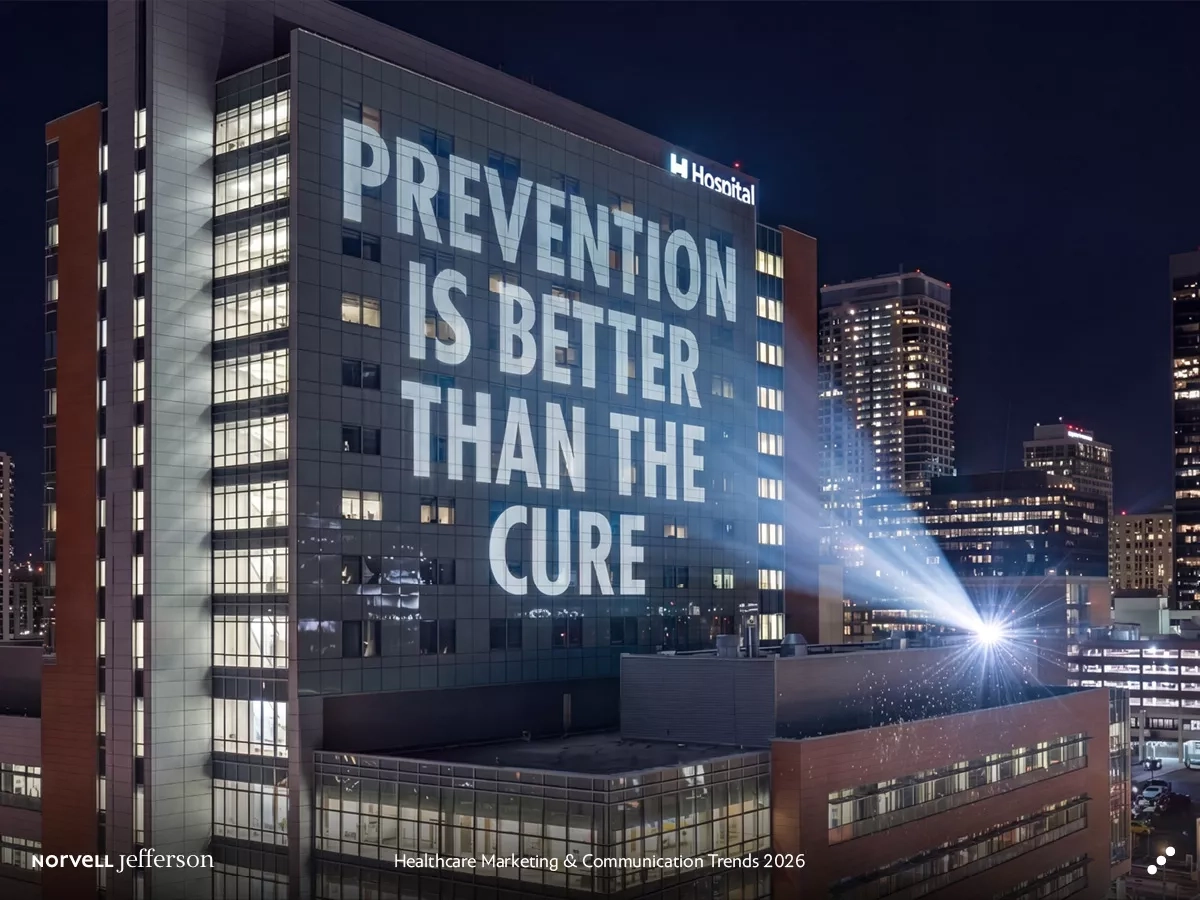
KEY INSIGHTS
of this report
Chapter 1: Proof over promise
Chapter 2: Evidence meets emotion
Chapter 3: The strength of transparency
Chapter 4: Breaking the sea of sameness
Chapter 5: When reach meets relevance
Chapter 6: Where storytelling becomes an experience shift
Chapter 7: From owned channels to earned influence
Image

Chapter 1: Proof over promise
In healthcare, the gap between what brands claim and what audiences believe has never been wider. Closing it does not require more communication. It requires a different kind. This chapter shows what proof-based communication looks like in practice and why, in a regulated and skeptical market, most communication fails without it.
Image

In healthcare, credibility has become both fragile and precious. Years of overclaiming and oversimplifying have dulled the impact of language. What used to differentiate now blends in, not because the words are wrong, but because they are used without anything to test them against.
Audiences have not become irrational. They have become precise in how they evaluate claims. They no longer accept language as evidence. They look for what can be shown, what can be verified, and what applies to their own context.
As a result, even strong messages struggle when they follow familiar patterns. Claims are no longer judged on their own. They are judged against everything the audience has already seen. What earns attention is not how something is said, but what can be demonstrated. Proof, more than persuasion, now defines credibility, whether through published outcomes, real-world impact, or evidence that can be directly evaluated.
Evidence has no power until it can be understood and used
Evidence has no power if it cannot be understood and used when it matters. Even strong data gets lost when it competes with too many other claims for the same moment of attention. A clinical outcome buried in a PDF will not influence a decision.
The challenge is not that health audiences reject data. It is that most data arrives without context, without hierarchy, and without a clear answer to the question a specific audience actually needs to answer.
Turning data into something a clinician, decision-maker, or patient can act on is not a creative exercise. It is a strategic one. Clarity is a form of respect for the time your audience does not have.
Image
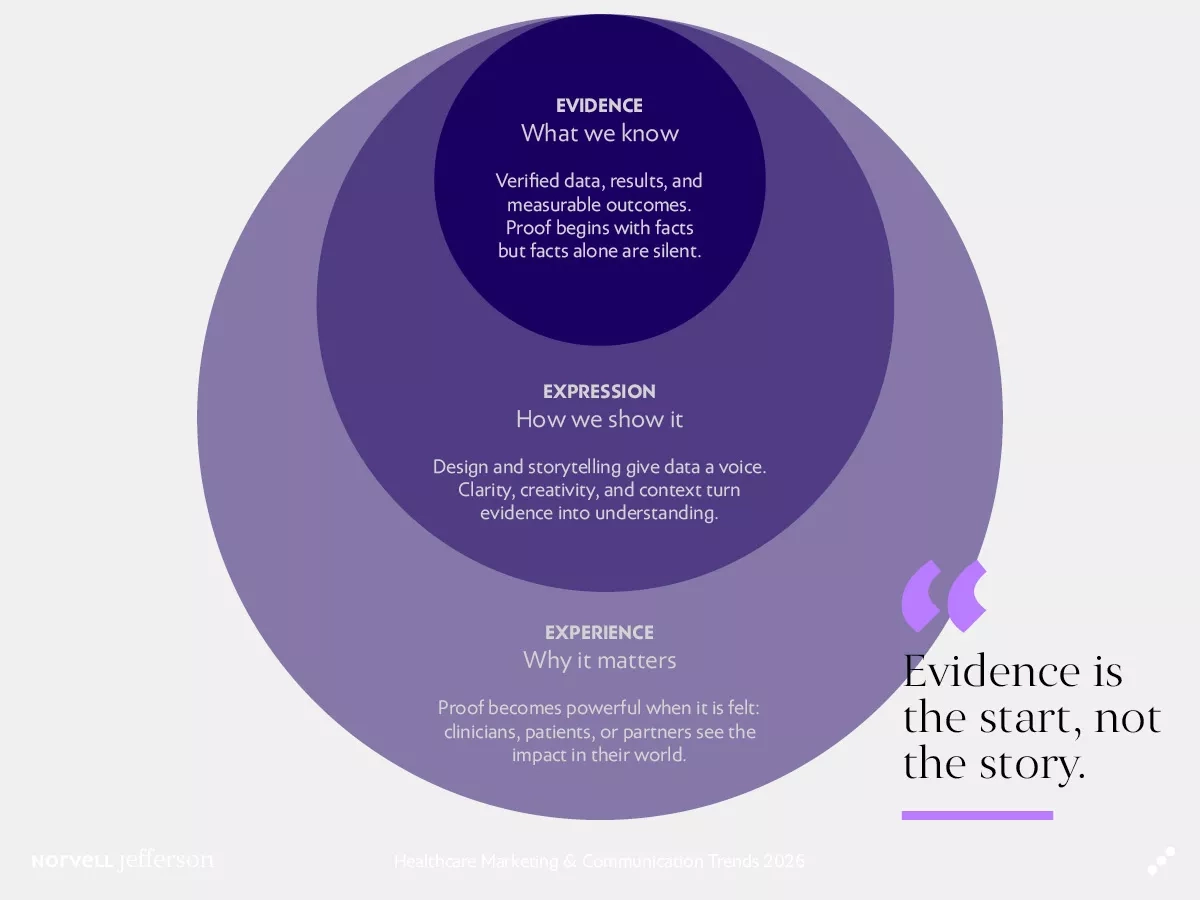
The proof RIPPLE
In healthcare, credibility no longer comes from what brands say. It comes from what they can demonstrate, and how clearly it is communicated. The Proof Ripple describes how evidence travels from what you know, through how you communicate it, to whether your audience recognises its relevance in their world.
The framework matters because most communication fails at one of the three layers, not all of them. Brands with strong evidence fail at expression, presenting data in a form no one can absorb. Brands with strong creative fail at evidence, producing content that cannot withstand scrutiny. Brands that get both right sometimes fail at experience, communicating accurately but without connecting to the operational reality of the people they are trying to reach.
To move the Proof Ripple from a framework to a filter, use it whenever a claim needs to be believed. In pharma and medtech, this means shifting the order of communication. Start with the evidence. Then explain what it means for the product.
It also aligns with how compliant communication is evaluated. In regulated health communications, claims must be grounded in verifiable evidence, presented without distortion, and relevant to the audience receiving them. While frameworks differ across markets, the underlying principle is consistent: claims must be verifiable, relevant, and honestly presented.
The Ripple reflects that logic. Evidence anchors the claim. Expression reduces the risk of misinterpretation. Experience connects relevance without implying outcomes that cannot be substantiated.
The most effective communication is not created despite regulation, but because it works within it.
Image

Putting the ripples into practice
Evidence: audit the baseline.
Before making a claim, identify the specific data, study, or performance record that acts as your verifiable starting point. Without it, your message has no legal or commercial foundation. Regulatory reviewers and skeptical clinicians ask the same first question: where does this number come from?
Expression: design for scannability.
Experts have high cognitive loads; they should not have to hunt for the point. Use visual hierarchy to surface the most critical result first. Complex methodology can sit one layer deeper, available to those who need it.
Experience: connect to utility.
Proof is only felt when it solves a real problem. Frame your data around operational impact, showing how the evidence reduces a specific staff burden, shortens a decision cycle, or improves a patient pathway. Abstract outcomes do not change behaviour. Workflow-connected ones do.
Navigating the Compliance “Sweet Spot”
Finding the sweet spot between “too safe to be effective” and “too bold to be compliant” is where the most impactful healthcare communication lives.
Report, don’t promise.
The most effective way to stay compliant is to shift from product guarantees to real-world evidence. The most compliant claim is often the most credible one: a specific outcome, properly attributed, that can be verified.
Show your working.
Regulatory teams flag claims when the evidence feels hidden. Making the basis of a claim visible, whether through study attribution, sample context, or outcome definition, reduces that risk and gives clinicians a reason to engage rather than dismiss.
The cost of playing it too safe.
Generic statements are not legally neutral, they are commercially inert. A claim so broad it cannot be challenged is also so broad it cannot be believed. The brands that earn attention are those willing to make specific, substantiated claims. That is not a risk to avoid. It is a strategy to pursue.
Image
Chapter 2: Evidence meets emotion
Proof is not enough on its own. Evidence only matters when someone recognises what it means for them, in the context they operate in and the decisions they face. That moment is not rational alone. It is felt. Without it, even strong data remains distant. With it, it starts to matter.
Image

When emotion is generic,
it STOPS BEING HUMAN
Too often, emotion in healthcare communication is reduced to a formula: the same stock smile, the same lab scene, the same hands on shoulders. The intent is empathy. The result is distance. When every story looks and feels the same, sincerity disappears and the message that should move people instead blends into noise.
This is the paradox of generic emotion. The more it is used to connect, the less it connects. Audiences in healthcare, whether clinicians making decisions under pressure or patients navigating uncertainty, do not respond to communication that looks like it cares. They respond to communication that proves it. Emotion that has nothing behind it does not feel human. It feels managed.
The brands moving beyond this understand that emotion is not a layer added to communication. It is what happens when evidence is made relevant to a specific person in a specific situation.
A clinical result becomes felt when it is connected to the moment a patient regains something they had lost. A workflow improvement becomes meaningful when a lab manager recognises their own daily reality in the data. The emotion is not invented. It is drawn out of the evidence by showing what that evidence actually changes for a real person.
If healthcare communication wants to be believed and felt, it needs to move beyond illustration and into interpretation. Not showing what care looks like. Showing what it changes.
Image
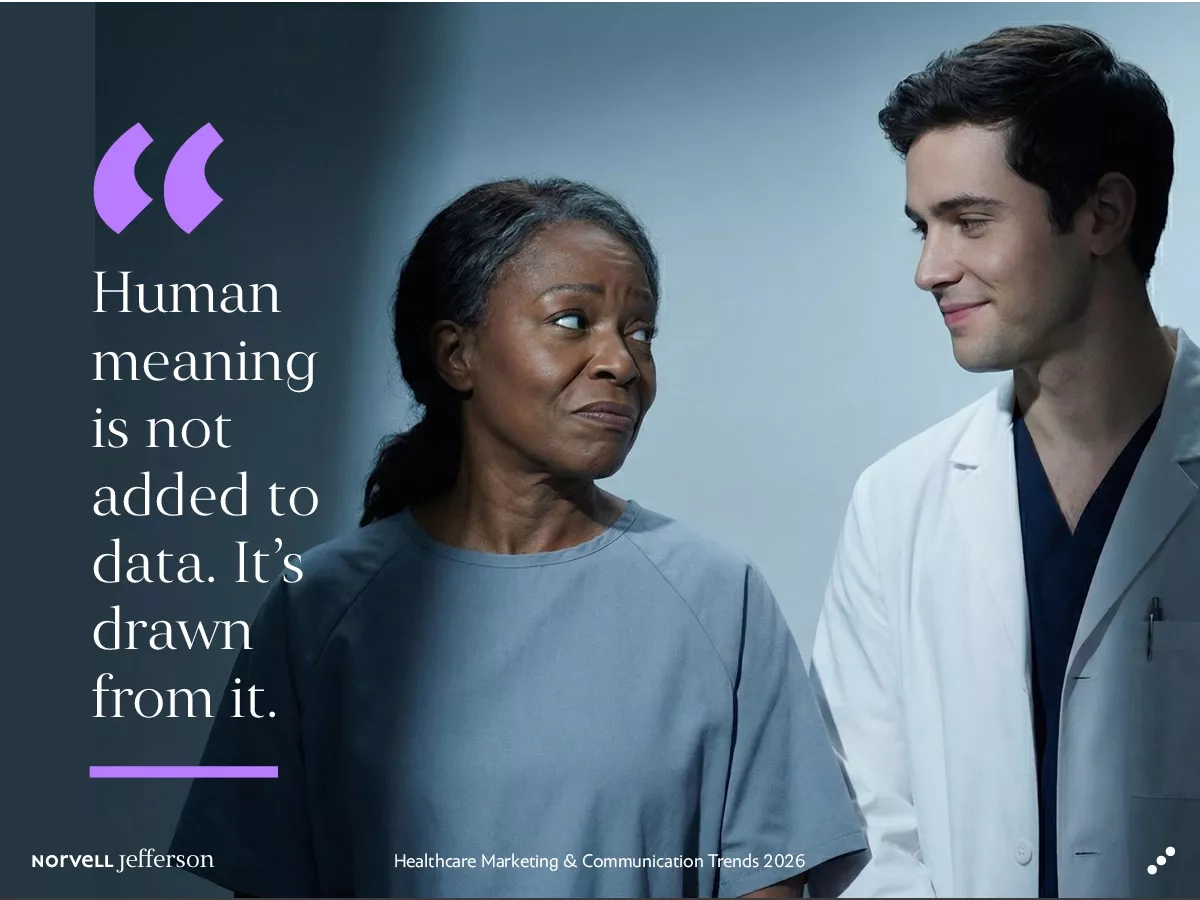
Data informs.
EMOTION TRANSFORMS.
Evidence gets you in the room. Emotion determines whether you are remembered when the decision is made. The brands that lead have understood that data alone does not move people, and feeling alone does not convince them. Proof gives people a reason to believe. Emotion gives them a reason to care.
When evidence connects to both the mind and the heart, it stops being information and becomes understanding. That is the moment when communication starts to matter, not because it is more persuasive, but because it reflects how decisions are actually made.
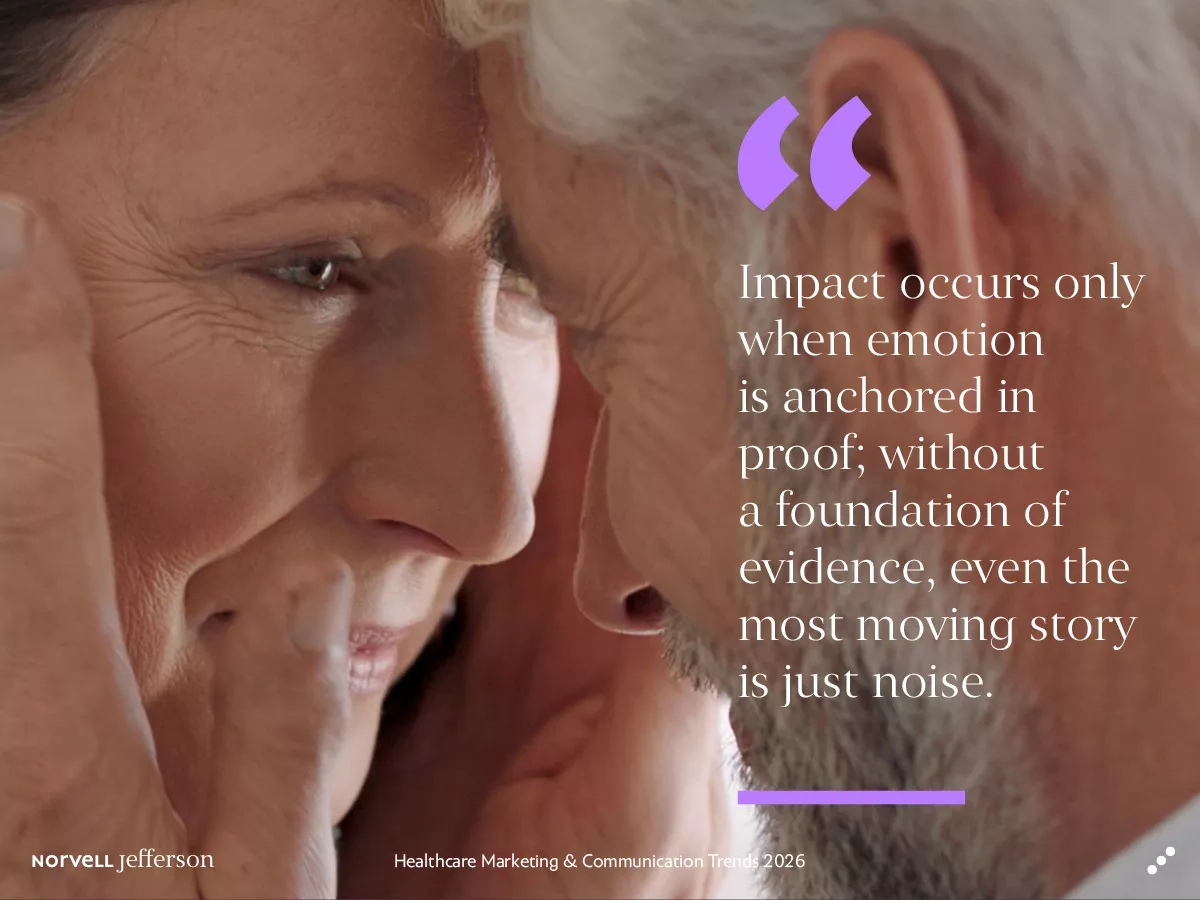
Impact = Proof x Emotion
Data informs, but when connected to genuine human relevance, evidence gains the power to move decisions and sustain belief.
Building on the equation Impact = Proof x Emotion, the shift is from formula to application. For communication to truly matter, it must go beyond illustrating a fact and move into interpretation. This means showing not just what the care looks like, but what it changes, for whom, and why that change matters in their specific context.
In a noisy market, impact means moving beyond being merely believed to being felt. This approach relies on the proof established in the previous chapter, ensuring that every emotional narrative is grounded in evidence that can be verified. Without proof behind it, emotion is just decoration. With it, it becomes something people remember and act on.
Image

MEDTECH CASES
Giving innovation a HUMAN HEART
MedTech communication often disappears into technical specifications. We break that pattern by showing what a product actually changes for the people who use it and the patients who benefit from it.
Image
MEDTECH CASE 01
Humanizing automation through STORYTELLING
When launching a complex laboratory automation system, we shifted away from a pure focus on speed and error rates. By tying the system’s unique value to an emotional story, we positioned the technology as a solution that touches care directly, making mechanical progress feel human rather than mechanical.
Image
MEDTECH CASE 02
The INTERSECTION of patient and provider
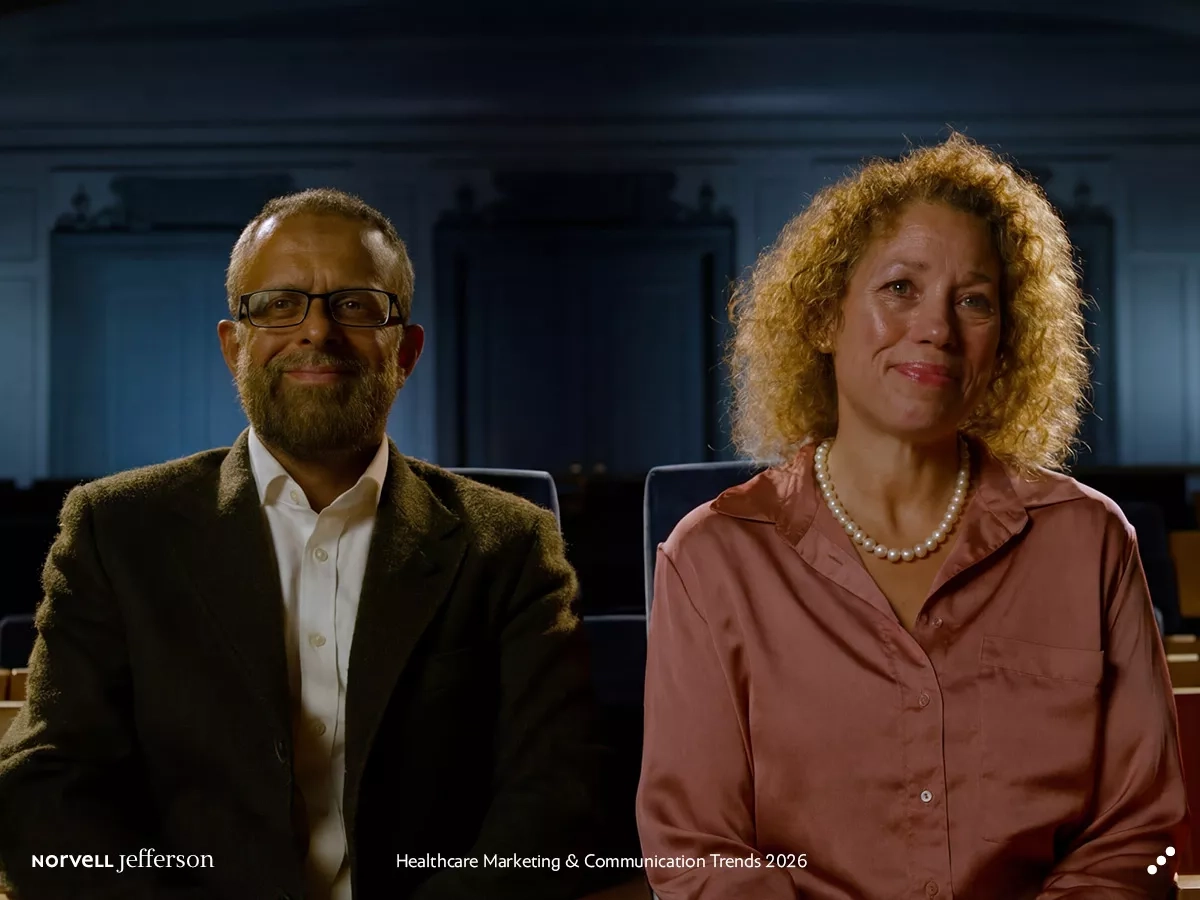
To create felt proof for heart rhythm disorders like Afib, we organized a meet-up centered around a unique musical composition. A composer listened to a patient’s experience of how Afib felt inside her body and translated those sensations into a musical score.
By having the HCP and patient listen to the piece together and reflect on it, we helped clinicians reach a deeper understanding of the disorder’s hidden impact, using music to bind their stories together.
Image
MEDTECH CASE 03
Giving SENTIENCE to systems
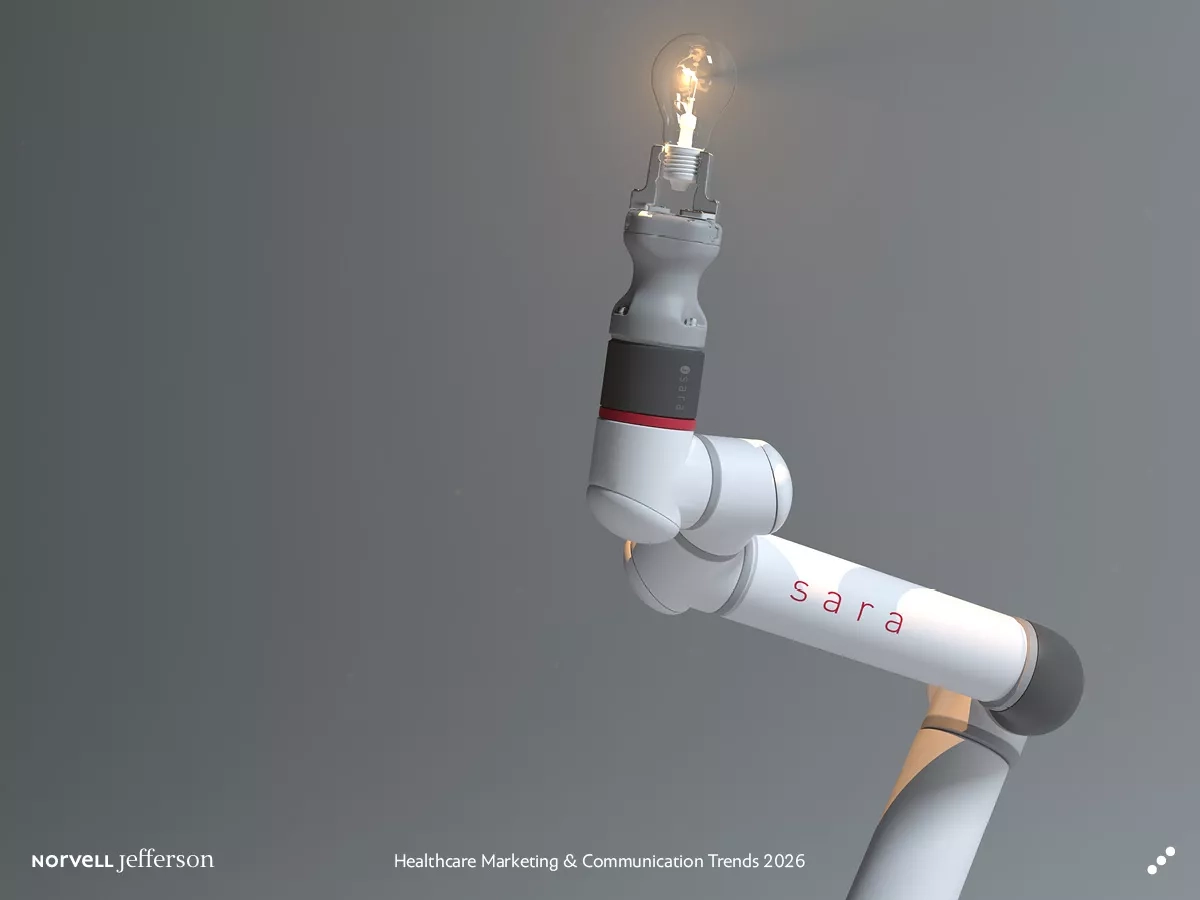
By providing a technological interface with a relatable persona, we transformed a piece of cold hardware into a virtual colleague. This approach ensures that the unique value of the innovation is not just believed to be efficient based on technical specs, but felt to be a supportive partner in the lab.
Image
PHARMA CASES
Telling the AUTHENTIC STORIES behind the science
In Pharma, the challenge lies in capturing the human truth that data often overlooks. We use artistic expression to strip away the marketing polish, revealing the authentic stories of both patients and physicians. Behind every treatment is not just a trial statistic, but a person and a family whose lives are fundamentally affected by a disease.
When you tie the proof of the previous chapter to authentic emotion, not stock generics, you connect with both the rational and emotional mind. These personal narratives represent the ultimate why behind the science, turning clinical evidence into a shared human mission.
Image

PHARMA CASE 01
Projecting the reality of CHRONIC DISEASE
For psoriasis, we developed a multilayered campaign to help dermatologists look beyond the skin. While the disease is visible on the surface, it often hides a systemic burden underneath, such as psoriatic arthritis, which can permanently damage joints.
To tell the authentic stories of these patients, we conducted in-depth interviews and projected their deepest passions, such as surfing and cycling or playing with their children, directly onto their skin. This artistic choice served as a clear reminder that if you only treat the surface and ignore what is happening underneath, you are not just ignoring a symptom, you are endangering the very life and identity of the person in front of you.
Image

PHARMA CASE 02
The unfiltered TRUTH of physical pain
To address the hidden burden of chronic back pain and create awareness around axSpA for both patients and HCPs, we invited an artist to paint the physical sensations described by patients.
This enabled a raw, real conversation about the complex nature of the disease, replacing traditional marketing with a recognizable moment of relief for both the patient and their family. By visualizing the specific, internal weight of axial spondyloarthritis, we helped bridge the communication gap between the person suffering and the clinician providing care.
Image
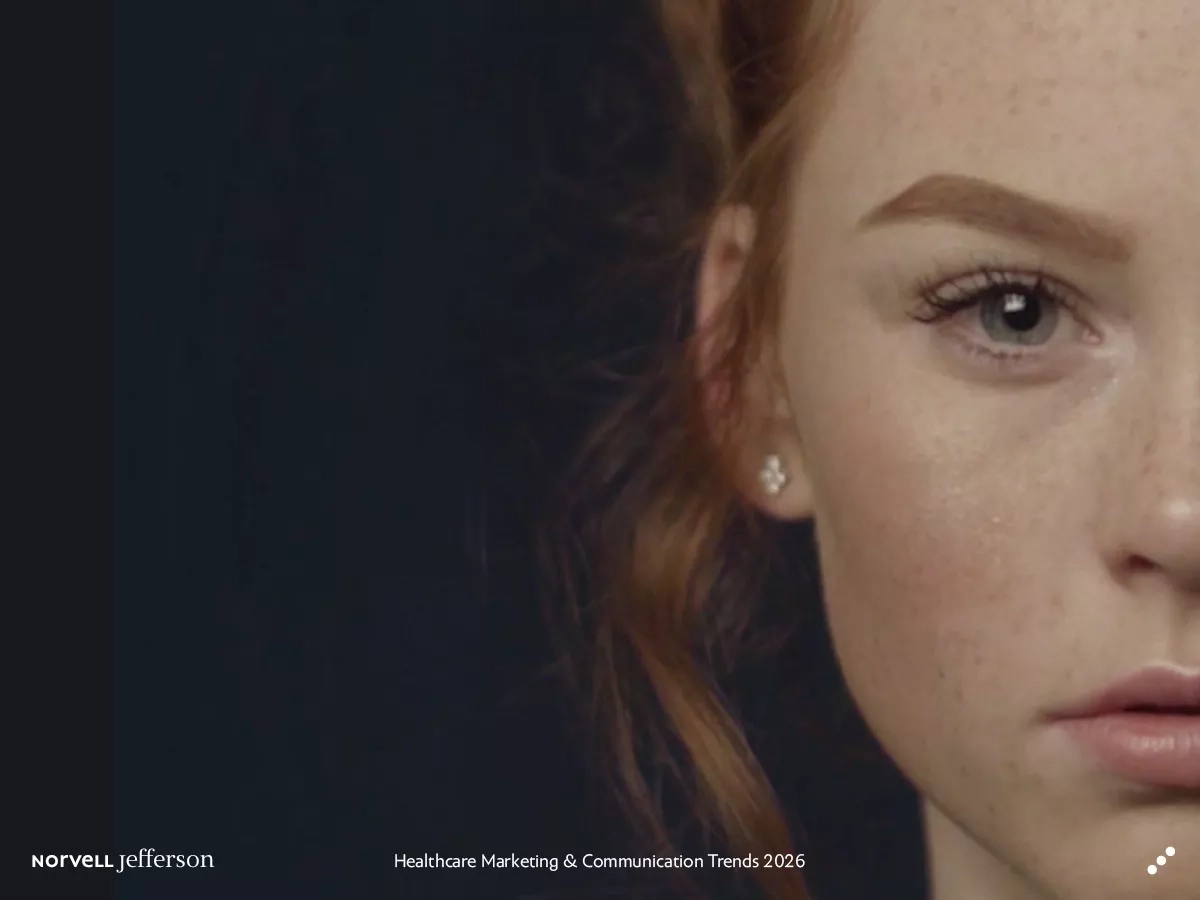
PHARMA CASE 03
Visualizing the meaning of SIGHT
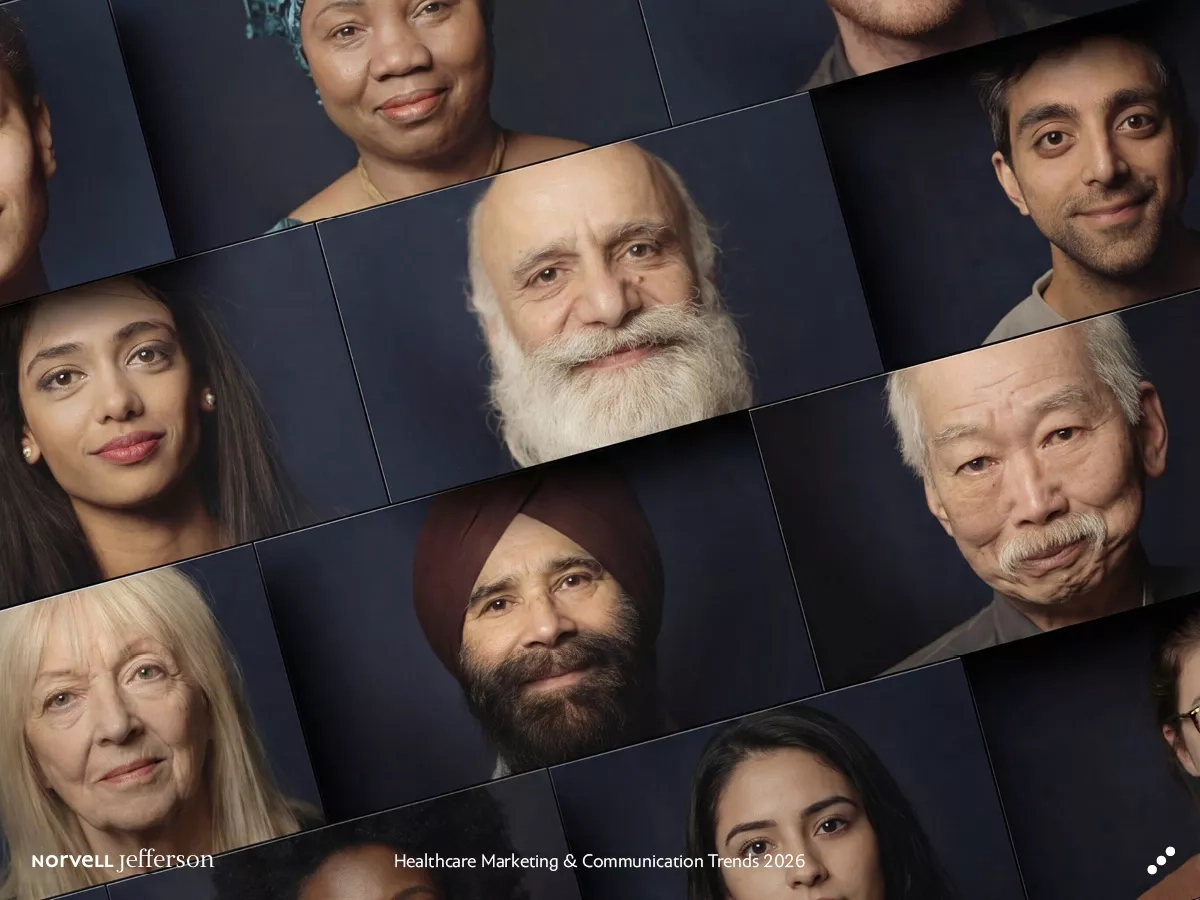
In vision care, we moved past the anatomy of the eye to focus on the personal story of what sight enables for a human life. Recognizing that every human and every eye is unique, we worked with a diverse collection of real people to tell their individual stories. By grounding the narrative in the preciousness of visual connection, we gave the scientific discovery a human dimension that regained its power to inspire.
The moment science becomes SINCERE
As these cases show, the emotion was already in the data. It just needed to be made visible. When science is connected to what it means for real people, it does not just inform. It moves people. And communication that moves people is what changes minds and builds lasting belief.
Image

Chapter 3: The strength of transparency
Healthcare brands already operate within strict rules on what can be said, how it must be substantiated, and who it can reach. Transparency does not challenge those boundaries. It shows how clearly communication is connected to the reality behind it.
The difference is not how much you say. It is whether that underlying reality is still visible, or has been replaced by a polished version of it. This chapter is not about saying more. It is about making communication credible by grounding it in something real.
Image
TRANSPARENCY is not about saying everything. It’s about explaining what matters.
For years, transparency was treated as a compliance exercise, a rule to be managed rather than a strength to be shared. But the context has changed fundamentally. In a world where any claim can be checked, challenged, or contradicted within seconds, the brands that hide behind broad claims do not appear cautious. They appear evasive.
In healthcare, transparency does not mean saying everything. It means making what must be said clear, contextual, and usable. Those boundaries are already defined by regulation, confidentiality, and patient safety. Within them, the choice of how clearly and honestly you communicate is entirely yours.
The brands that earn trust use openness to clarify rather than defend. They explain how data is generated, how safety is safeguarded, and how innovation serves real needs. This kind of honesty does not weaken authority. It strengthens belief, because it helps people see the science in full rather than in fragments.
Transparency lives in how results are framed and how limitations are acknowledged. It means explaining what a data point represents and how it fits into real care. These are not just disclosures. They are designs for trust. Transparency starts small.
Image
Transparency in healthcare is not only an external exercise. It runs in two directions, and the two are connected.
Externally, it shows up in grounded communication, in the context around results, the visibility of processes, and the way expertise is explained so it can be followed and understood.
Internally, it shows up in how organisations communicate about themselves: how direction is shared, how decisions are explained, and how the reality behind research, development, and daily operations is made visible across the organisation.
Organisations that explain their work clearly to their own people tend to communicate more credibly to the outside world. The discipline is the same: making reality understandable without oversimplifying it.
It was not always this way. Internal communication once did more than inform. It explained. Over time, the drive to control the message began to shape internal communication too.
Updates became announcements and context became positioning, until less of the underlying reality was being actively shared.
External communication followed the same pattern, becoming more polished, more general, and less connected to how things actually happen.
Rebuilding transparency starts from within. Not with new formats or new messages, but with the ability to communicate openly about the reality behind the organisation, and translate that, carefully and compliantly, into communication that is grounded and real.
Image
The ANATOMY of transparancy
Transparency is not the path of least resistance. In most organisations, the easier choice is to stay general, stay polished, and avoid the friction that comes with making more of the underlying reality visible. Responsibilities are distributed, caution is built into every step, and the instinct to control the message runs deep.
Which is why transparency rarely starts as a system. It starts with individual choices.
For a marketing team launching a new medicine or medtech device, it might start with one decision: to show the study design alongside the result, rather than presenting only the headline number. To let a clinical specialist explain the evidence in their own words, rather than translating expertise into brand language. To show how the product fits into a real workflow, including where it is still being refined.
For a corporate affairs or brand team, it might start differently. A brand film that shows the people behind the company, not a produced version of them. Or communication that does not explain what the organisation values, but shows how those values show up in the work every day.
None of these are large gestures. None of them expose what must remain protected. But each one moves communication closer to how things actually work, and that distance, however small, is where credibility is built.
In an AI-shaped landscape, polished communication is abundant and increasingly indistinguishable. What remains distinctive is the reality behind it.
Image

MEDTECH CASE
How OPENNESS becomes your purest form of credibility
Letting clients speak
Instead of relying on scripted marketing or corporate clichés, a leading medtech brand adopted a documentary style approach to their customer testimonials. By capturing pathology professionals in their own environments, sometimes even highlighting their personal passion projects, they showed the person behind the function. This allowed the real world value of their technology to be felt through authentic human experience rather than just read as a feature list.
Showing the human impact
The campaign moved past the anatomy of the laboratory to focus on the passion and purpose of the people using the products. By using in-depth, unscripted interviews, the brand was able to substantiate its promise with real stories, turning a product testimonial into a human connection that resonated deeply with other pathologists.
Image
PHARMA CASE
Turning operational reality into PROFESSIONAL TRUST
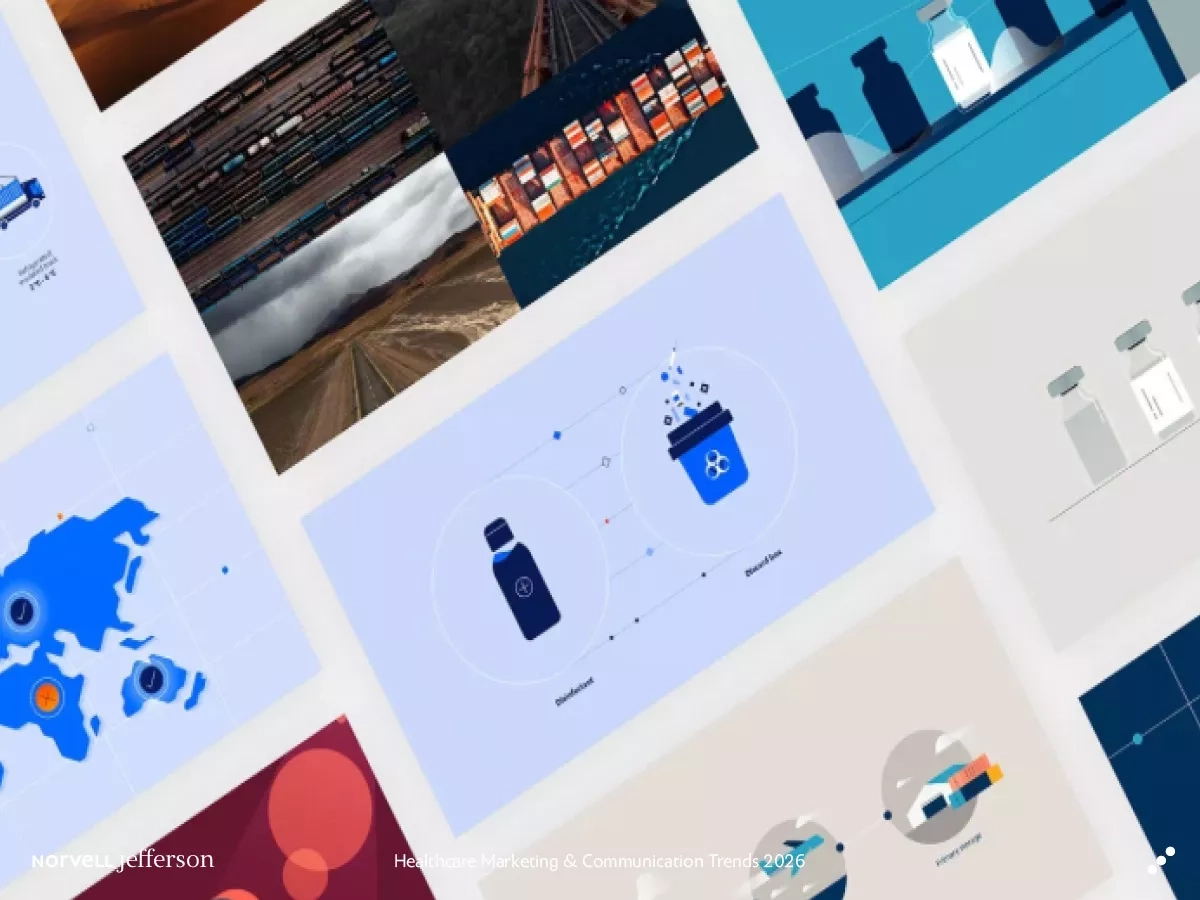
Opening the black box of logistics
In the pharmaceutical world, product integrity is often a hidden promise, but choosing to make it visible transforms a technical requirement into a mark of quality. By pulling back the curtain on ultra cold storage and transport, a company moves from a corporate posture of reliability to a clear demonstration of the intense, behind-the-scenes work required to ensure a product reaches its destination safely. This approach replaces the “trust us” slogan with a “see how” reality, mapping out the complex journey from laboratory to patient to provide the honest context needed for a narrative of true care.
Substantiating safety through process
Transparency is at its most potent when it acknowledges what can go wrong, turning potential risks into proof of rigorous control. By showing the reality of a broken cold chain, such as a temperature excursion that renders a batch unusable, you demonstrate that your safety protocols are designed to prioritize the patient over looking perfect. Acknowledging what can go wrong, and showing how it is handled, builds more trust than pretending it never happens.
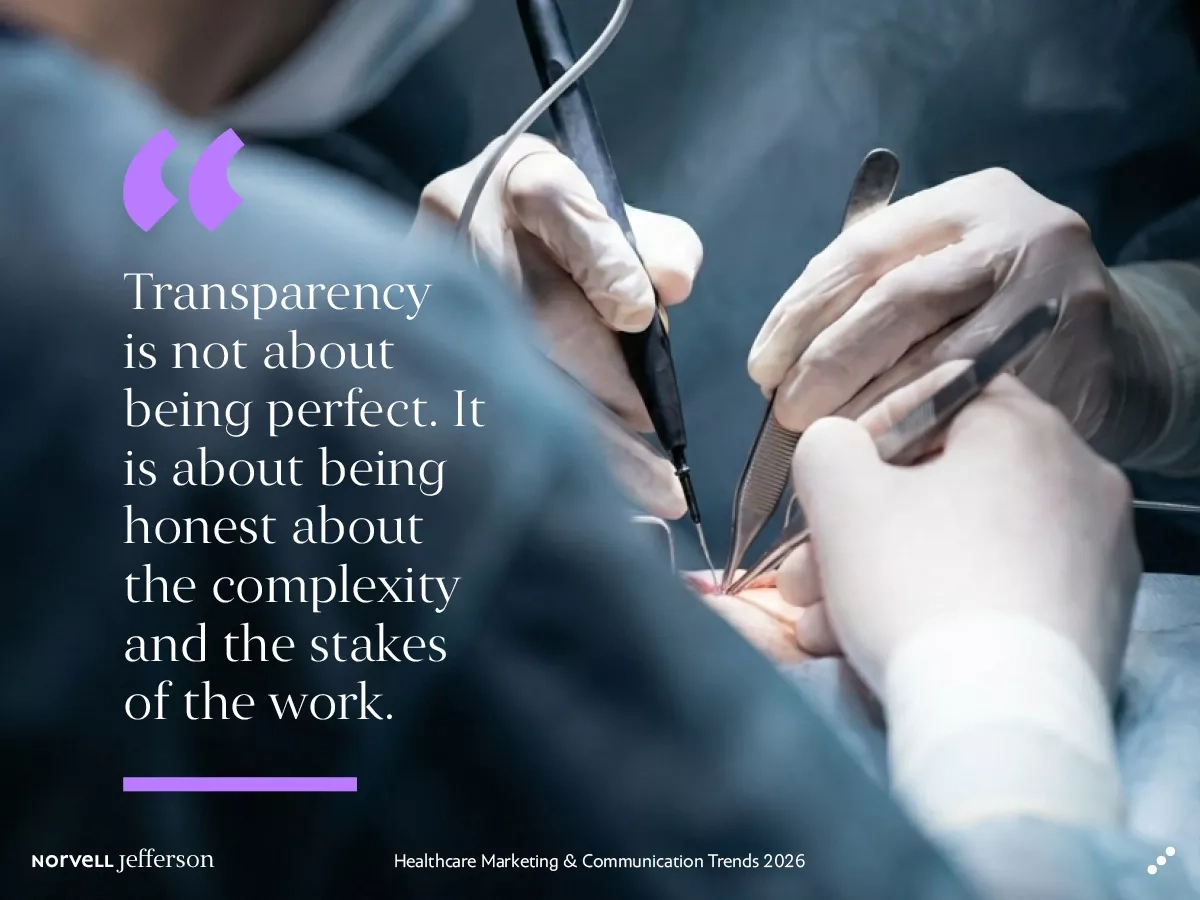
"Transparency is not about being perfect; it is about being honest about the complexity and the stakes of the work."
Image
Chapter 4: Breaking the sea of sameness
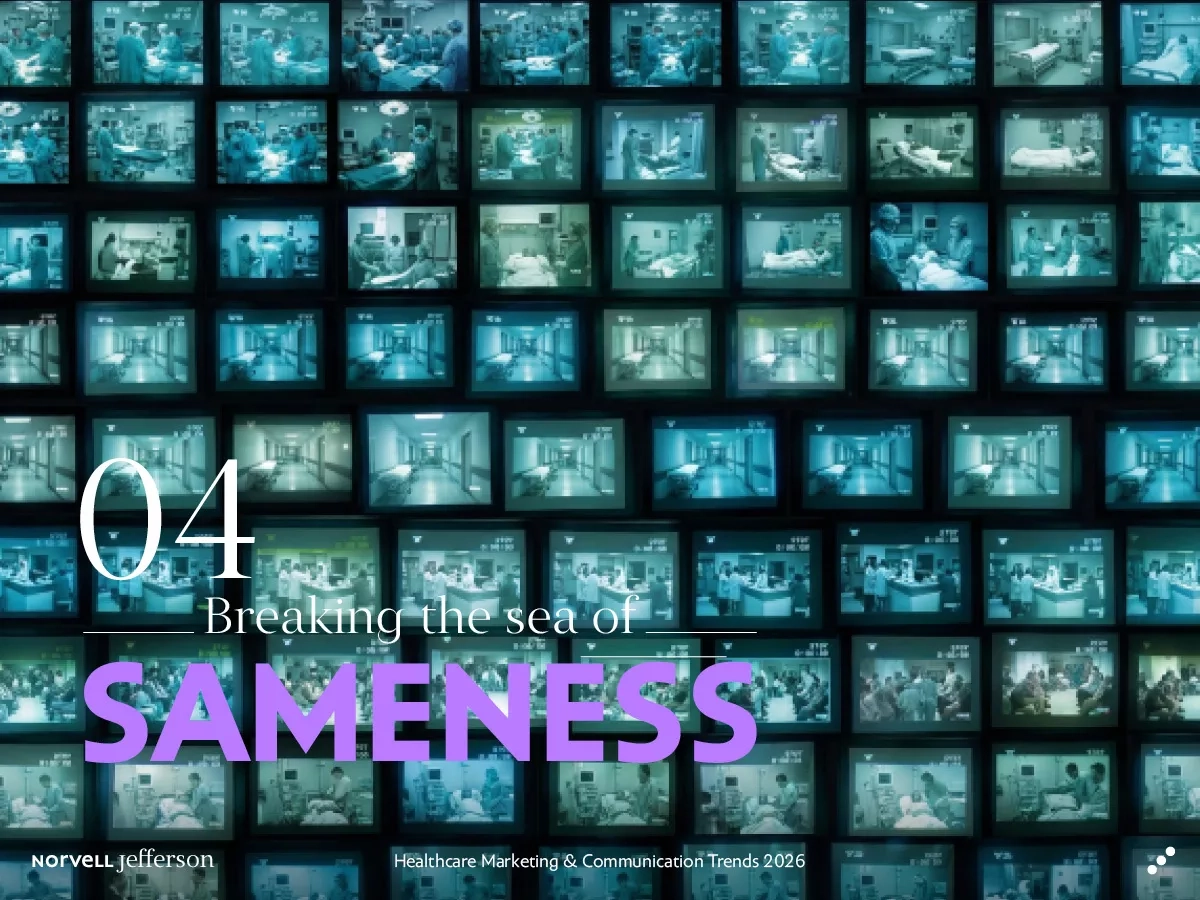
In healthcare, sameness is not chosen. It accumulates. No brand sets out to look like every other brand in its category. No marketing team briefs an agency to produce something forgettable. And yet, across pharma and medtech, the same blues and whites appear, the same stock imagery of smiling clinicians, the same language of precision, innovation, and care.
The reason is not regulation. It is pattern. Once a category develops a recognisable look, departing from it feels risky. Blending in feels safe. Followed by everyone, it produces a market where no one is visible. Sameness is not a failure of creativity. It is the natural outcome of a system designed to minimise risk.
Image

The healthcare market is not only drowning in noise. It is drowning in similarity. The problem is not volume. It is that the brands competing for the same audience have ended up with the same solutions, the same palette, the same language.
This uniformity is not accidental. In medtech, products often look similar because the category established a visual template early, and every subsequent brand entered that template rather than challenging it. In pharma, breakthrough claims rely on an identical vocabulary. Every brand claims the same qualities: precision, reliability, innovation.
The result is not just a creative problem. It is a cognitive one. When every brand looks and sounds the same, audiences stop seeing the category altogether. The brain does not process what it has already learned to ignore.
In healthcare, differentiation is not avoided by accident. It is designed out of the system, one safe decision at a time.
Image

The creative imperative of the UNFAIR ADVANTAGE
The unfair advantage is the specific, ownable space a brand occupies that no competitor can credibly claim or copy. It is not a clever slogan. It is something the brand genuinely does, or genuinely delivers, that no one else can honestly say.
In a category where everything looks the same, difference is not a creative choice. It is the only way to be seen.
But the visual is only the door. What comes after is what matters: the position that sits at the intersection of what the brand genuinely does and what its audience genuinely needs.
The leadership challenge is not aesthetic. It is strategic. It means finding that unfair advantage and having the conviction to lead with it, instead of saying what the category already says. Regulatory review governs what a brand can claim. It does not govern whether the brand is worth paying attention to. Being safe and compliant does not mean being boring. And while a competitor can copy a visual identity, they cannot copy the unfair advantage behind it.
Image
Image
Breaking the VISUAL CONTRACT
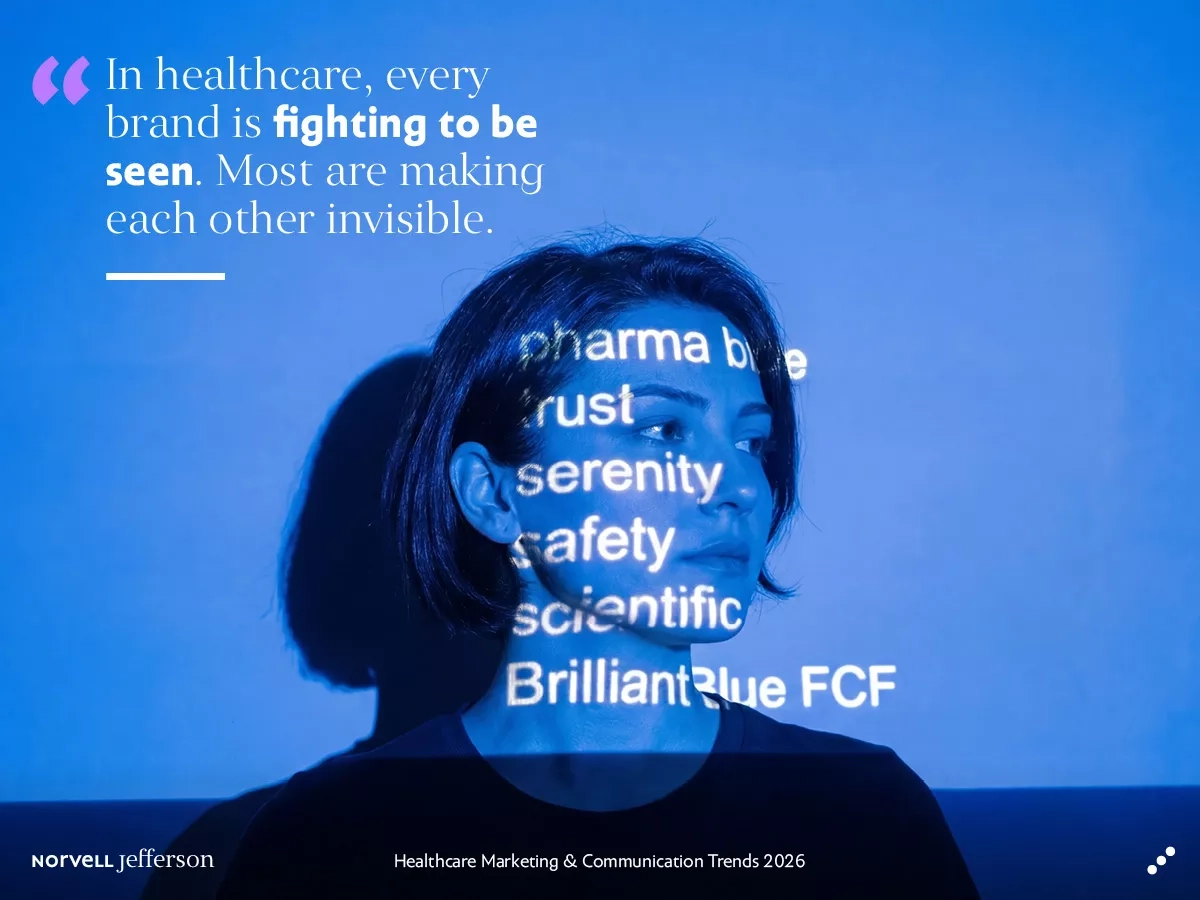
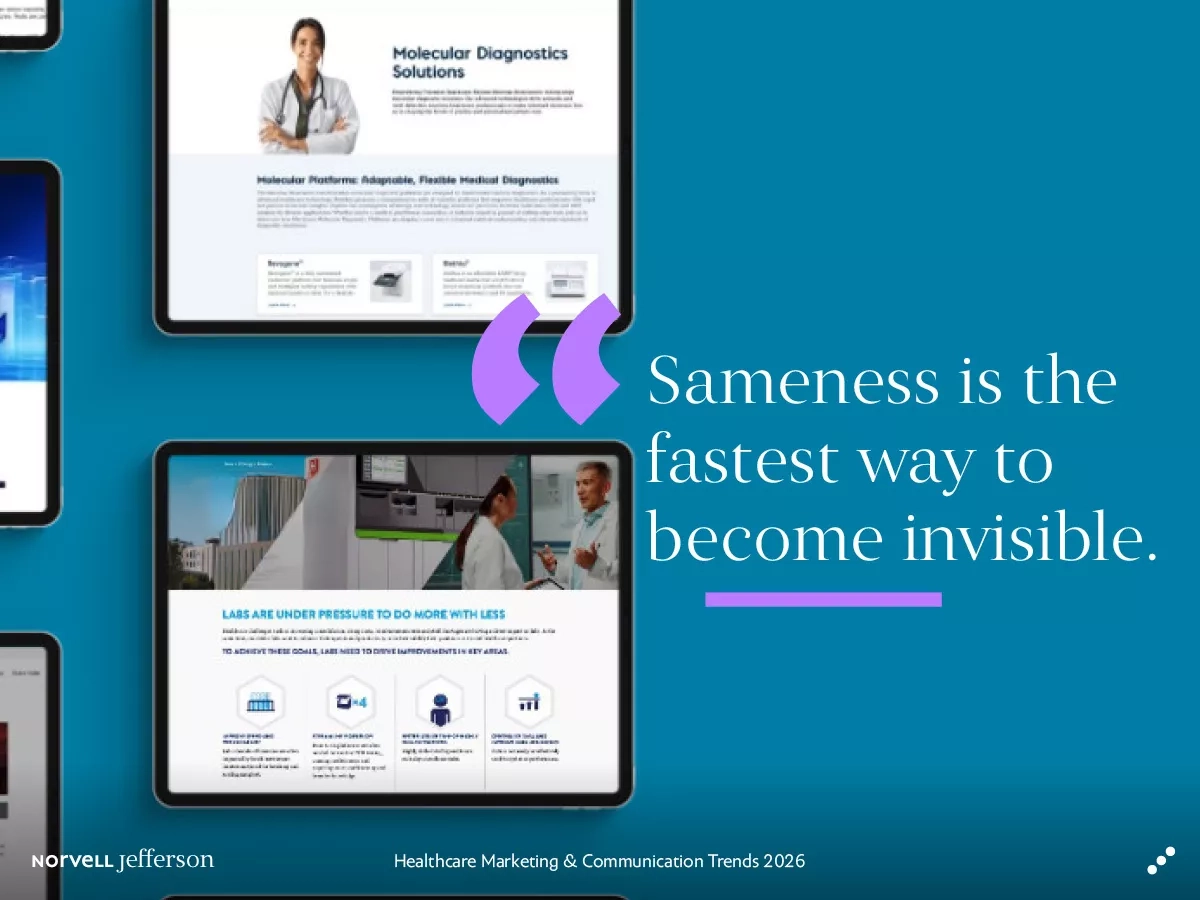
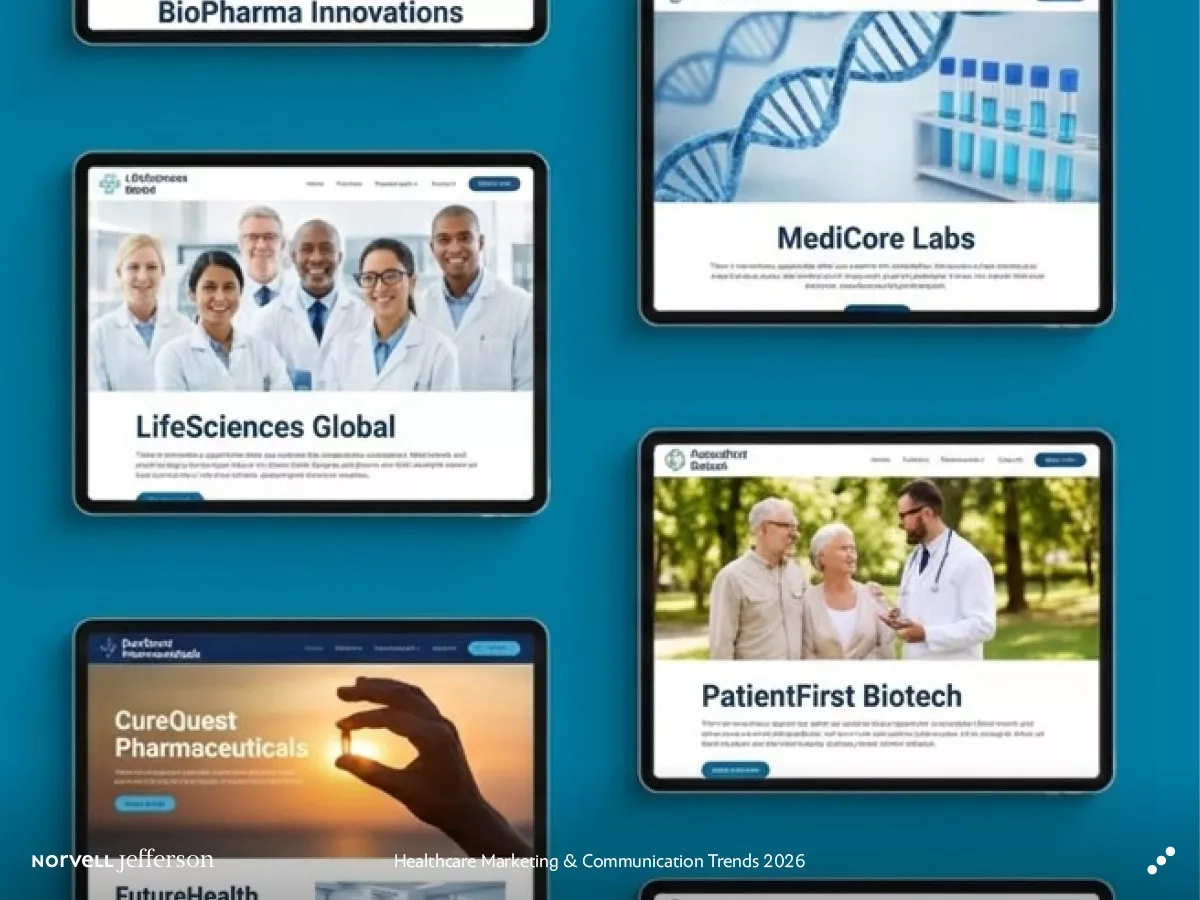
The visual contract is the unspoken agreement that all brands in a category will look and sound the same. Most brands conform to it without thinking. That is exactly why breaking it creates such a disproportionate advantage. In a market where everything looks the same, the brand that looks different gets noticed first, remembered longer, and trusted sooner. Not because it spent more. Because it chose to stand apart.
Breaking the contract does not mean ignoring the audience or abandoning credibility. It means building a visual and verbal system that is intentionally designed to look and feel different from the category, not as a stylistic choice, but as a strategic one. Authentic, grounded visuals. A colour palette that does not echo the competition. A verbal identity that does not borrow the category’s language. The verified claim made visually engaging, not buried in a layout that looks like everyone else’s.
Because humans are inherently visual, the visual system operates as the primary filtering mechanism before conscious attention is engaged. A brand that looks generic will be classified and dismissed before a single word is read. The visual is not decoration. It is the first and often only test a brand passes or fails.
Trapped in the industry visual contract
Most MedTech and Pharma competition remains trapped in a “visual contract” of indistinguishable blue-and-white clinical clichés, corporate colors, and stock imagery. This uniformity creates a forgettable background hum where products appear as commodities and technical specifications blur together.
The disruptive alternative
True differentiation replaces repetitive graphic language with authentic, grounded visuals and unique color palettes. By using intentionally designed systems that look and feel different, a brand immediately commands attention and earns trust.
Image
The blend of STRATEGY & SOUL
Finding the unfair advantage is not a creative exercise. It starts with an honest question: what does this brand genuinely do that no one else does? Not what it claims. What it actually delivers, day after day, in the hands of the people who use it. The answer to that question is the foundation of everything. The visual system expresses it. The narrative carries it. The sales conversation leads with it. When strategy and soul move together, differentiation is not something a brand tries to achieve. It is something the audience simply recognises.
The default blueprint: predictable & invisible
Most brands remain trapped in an industry “visual contract” of indistinguishable blue-and-white clinical clichés. Because this expected look offers no pattern-break, the human brain automatically filters it out as background noise.
The strategic alternative: bold & authentic
True differentiation is a holistic blend where your graphical language, values, and brand promise move in unison. By aligning how you look, what you say, and how you act, you penetrate the visual filter and build a bond of trust no competitor can mimic.
Image
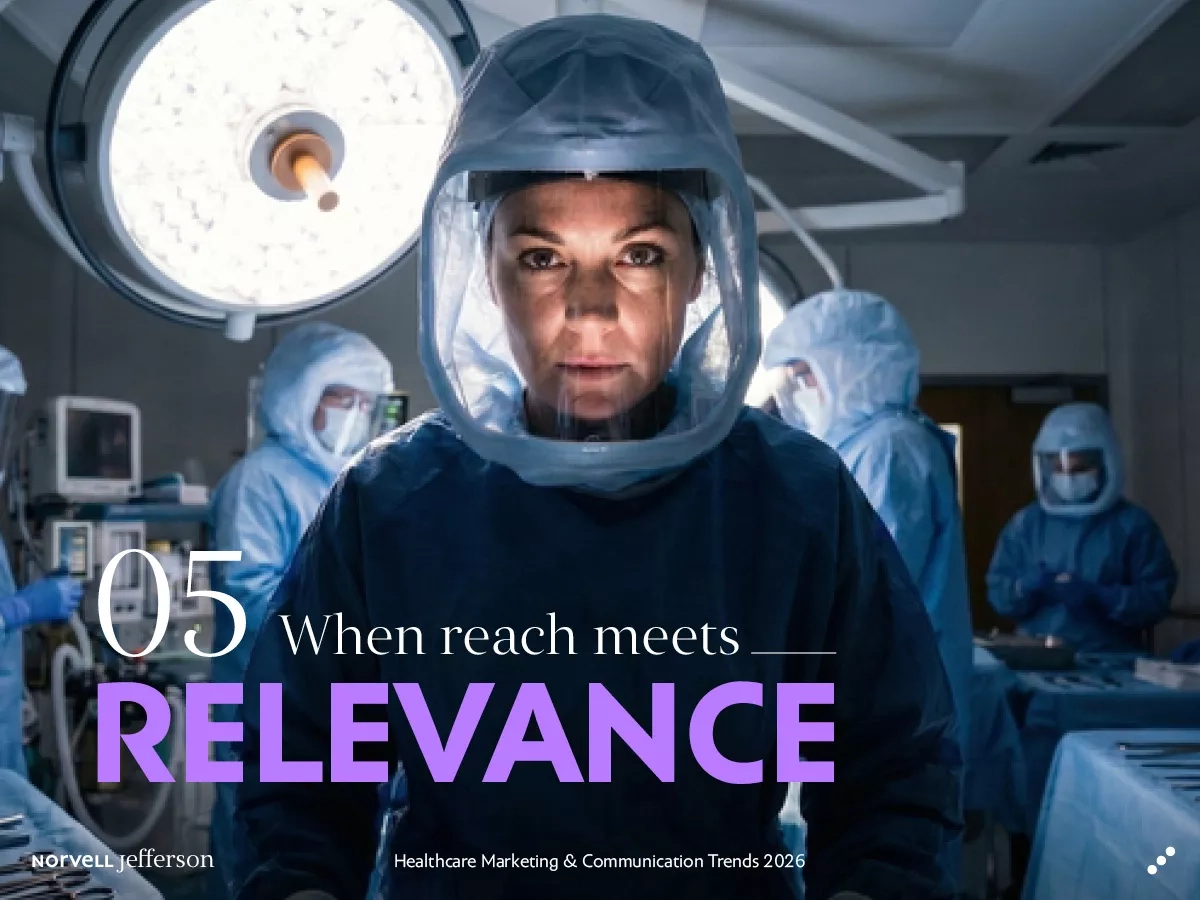
Chapter 5: When reach meets relevance
Getting through has never been harder. Inboxes are full, feeds are filtered, and attention is rationed. Even when a brand breaks the sea of sameness, earns trust through proof, and communicates with transparency, there is still one final test. Was it relevant to this person, at this moment, for what actually matters to them?
If not, it will be ignored. Not because it was wrong. Because it was not theirs. Relevance is not a technique. It is the difference between a message that serves the brand and one that serves the person receiving it. This chapter is not about reaching more people. It is about meaning more to the ones you already reach.
Image
Where communication becomes USEFUL
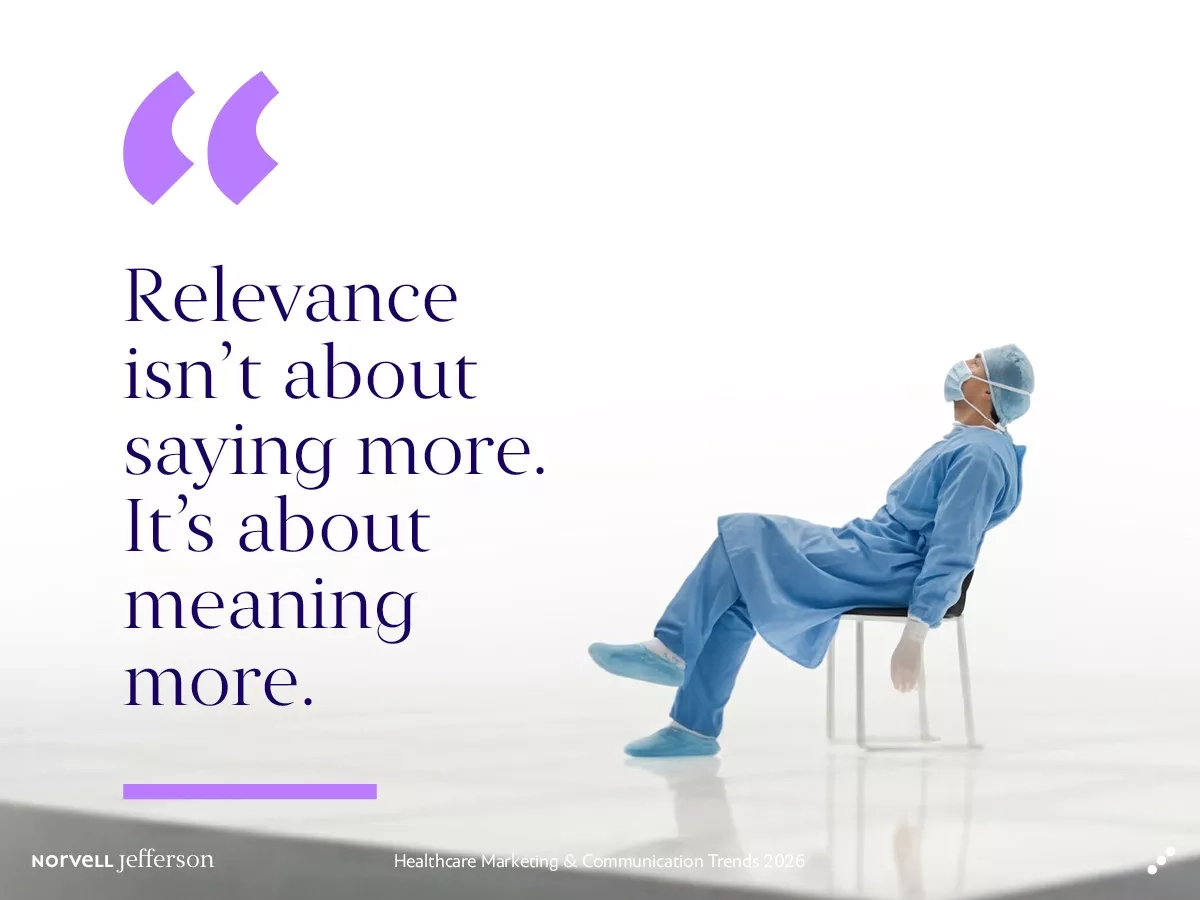
Most communication in healthcare still starts with what a company wants to say. It is structured around the product, the data, the brand. Then it is targeted, distributed, and measured by how many people it reached. What it rarely measures is whether anyone found it useful, or whether it meant anything to the person on the receiving end.
Relevance is not created by reach. It is created when what you say connects directly to what your audience is dealing with.
That recognition does not happen by accident. It requires understanding not just who your audience is, but what they are actually dealing with. The HCP who has nine minutes between patients. The lab manager whose team is understaffed. The patient who has already read everything online and trusts none of it. The procurement lead who needs to justify a capital investment to a board that will ask hard questions.
When communication reflects that reality rather than talking past it, something changes. It is no longer processed as a message. It is received as something useful. And useful communication is shared, remembered, and acted on in ways that reach alone cannot produce. The brands that lead today are not louder. They are more precise. They have stopped optimising for contact and started optimising for recognition.
Image
The RELEVANCE loop
Relevance is not a single act. It compounds.
The first time a brand communicates something that genuinely reflects an audience’s reality, it earns a small amount of trust. The second time, that trust makes the next message easier to receive. Over time, if the pattern holds, something shifts. The audience stops filtering the brand out. They start paying attention.
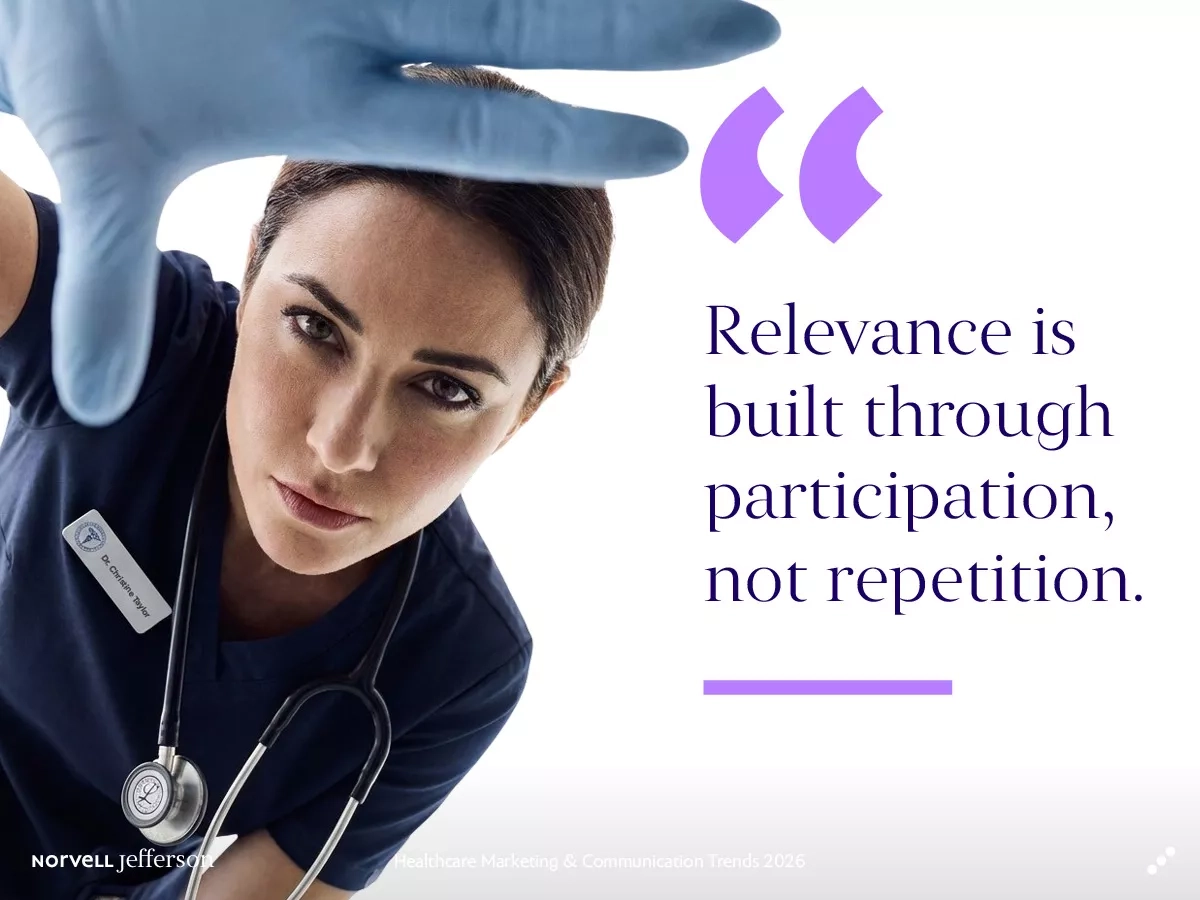
This is how relevance builds. Not through repetition, but through recognition that accumulates. Each interaction that reflects reality strengthens the connection. Each one that misses weakens it again. Participation is the most direct way to build that recognition. But it is not the only one.
Most communication in healthcare is not interactive. A clinician reading a whitepaper is not in dialogue. A patient watching a video cannot respond.
A procurement lead reviewing a proposal is not co-creating anything.
And yet, the loop still works. Because relevance does not depend on interaction. It depends on accuracy. A brand that consistently communicates something useful, grounded in the reality of its audience, builds trust over time, even without direct participation. The audience begins to recognise that this brand understands their world. That recognition is a form of participation. Passive, but real.
The brands that understand this do not rely on response. They behave as if they already understand the audience, every time they communicate.
Participation accelerates the loop. Accuracy sustains it.
Image
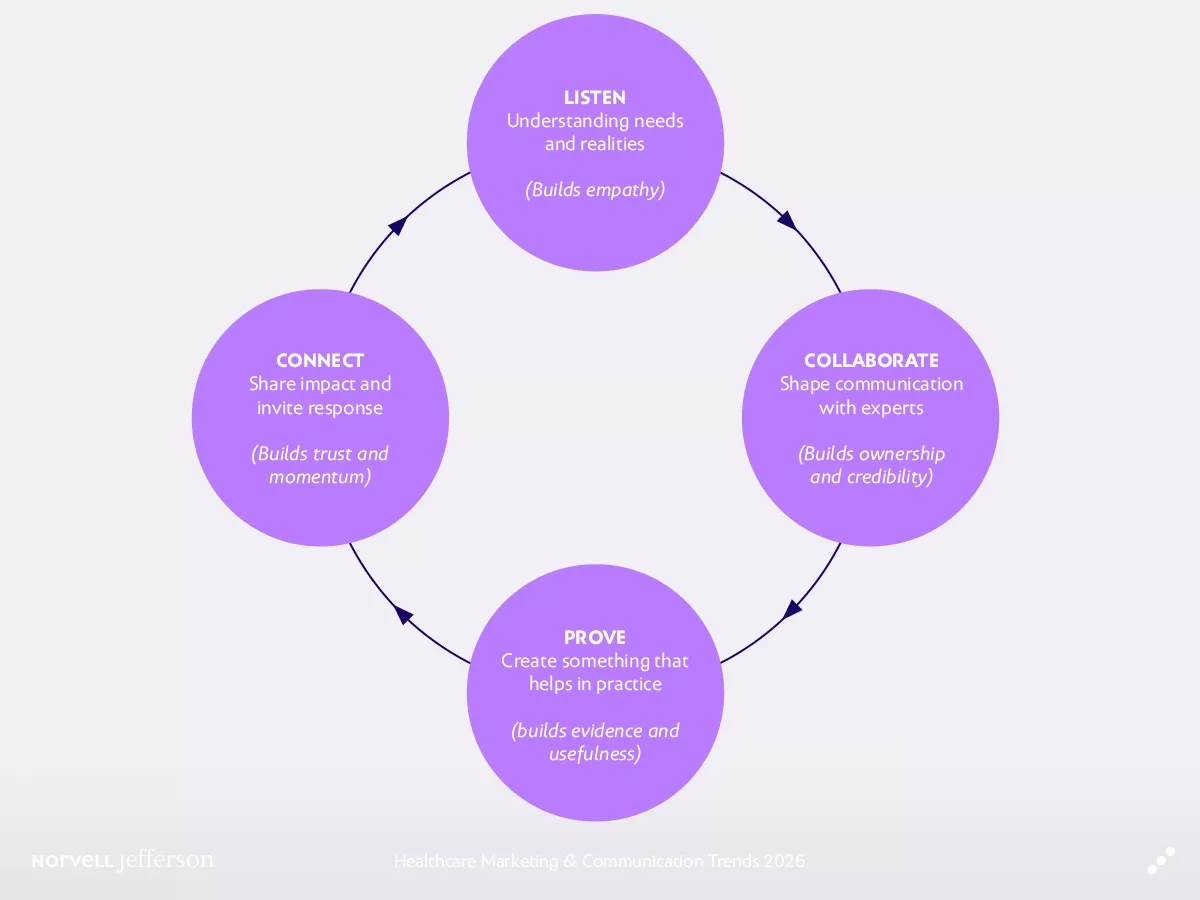
From interruption to RELEVANCE
Capturing attention is only the beginning. In healthcare, where audiences are time-pressured and skeptical, attention that is not immediately useful is immediately lost.
The shift is not from interruption to participation. It is from interruption to relevance. Instead of delivering a message, a brand creates something the audience recognises as useful. Something that reflects their reality closely enough to be worth their time.
That can take different forms.
LISTEN
Understanding needs and realities
It starts here. Not with a message, but with a clear view of what the audience is actually dealing with. Not the version that fits the brief, but the one that shapes their decisions. The clinical pressure. The workflow constraint. The risk they cannot afford to take. Communication that reflects this does not need to fight for attention. It lands.
COLLABORATE
Shaping communication with those who know
Relevance grows when the audience helps shape the message. This doesn’t require full co-creation. It can be a clinician’s input in a whitepaper, a KOL sharing experience, or a customer demonstrating real use.
What matters is authenticity: the result reflects more than the brand alone. HCPs are critical evaluators, and peer perspectives, clearly disclosed and grounded in practice, carry credibility brand messaging cannot match.
PROVE
Helping in practice
A brand promise only holds when it can be tested against reality. The most relevant communication gives the audience something they can apply directly. Not a claim, but something that helps them make a decision, solve a problem, or understand a situation more clearly. At that point, the brand is no longer just communicating. It is being used.
CONNECT
Keeping relevance in motion
Relevance does not require a response. But when a response happens, it strengthens the loop. When audiences share, return, or build on what was communicated, relevance compounds faster. Not because the brand asked for attention, but because it earned it. The brands that sustain relevance do not close the conversation with a campaign. They leave it open for the next moment where they can be useful again.
Image

The internal shift and the MARATHON MINDSET
The relevance loop does not fail because of the market. It fails because of how organisations are built.
Most healthcare brands are structured for interruption. Marketing works in campaigns. Sales works in calls. Both are optimised for contact, not for something people come back to because it helped them before. The two functions often run in parallel, occasionally coordinating, but rarely building toward the same outcome over time.
The shift starts when marketing stops creating reasons to be heard and starts creating reasons to come back. When sales stops opening with a pitch and starts with what is useful to this specific person today.
When both functions share an understanding of what the audience is dealing with, communication begins to feel less like a message and more like something that is actually used in practice.
This is not about restructuring the organisation. It is about changing what the work is for. The goal is not to dismantle silos, but to make them irrelevant by giving both functions a shared focus: the audience’s reality, not the brand’s calendar.
Building this kind of relevance takes longer than a campaign. It is measured in whether people return, not how many were reached. And it requires the patience to keep showing up with something useful, long before the audience is ready to act.
Image
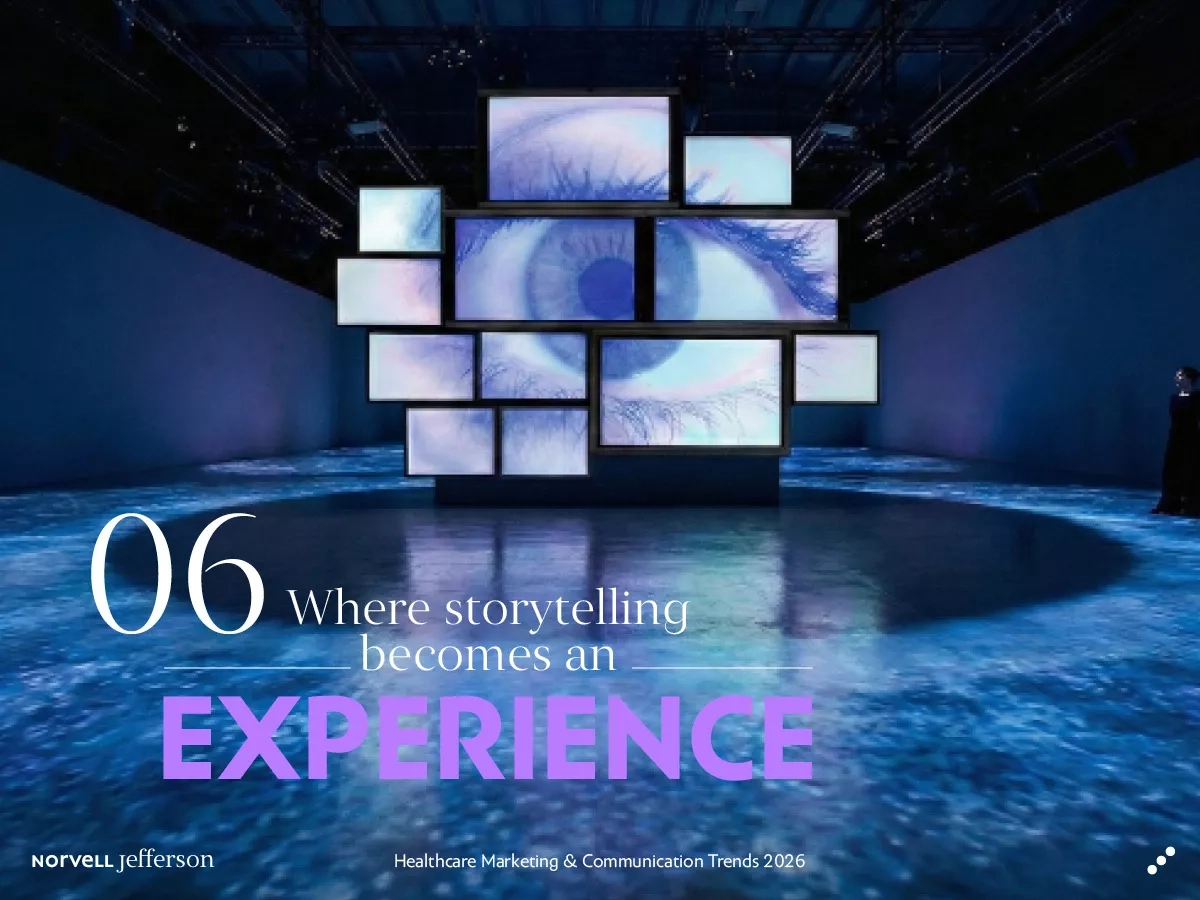
Chapter 6: Where storytelling becomes an experience
Getting the message right is no longer enough. In healthcare, brands have invested heavily in what they say. In proof, in differentiation, in relevance. And yet audiences are more resistant than ever. Not because the messages are wrong. Because the way they arrive no longer matches what people are willing to receive. Not every moment needs an experience. But the moments that matter most deserve more than the standard marketing toolkit can offer. This chapter is about those moments.
Image
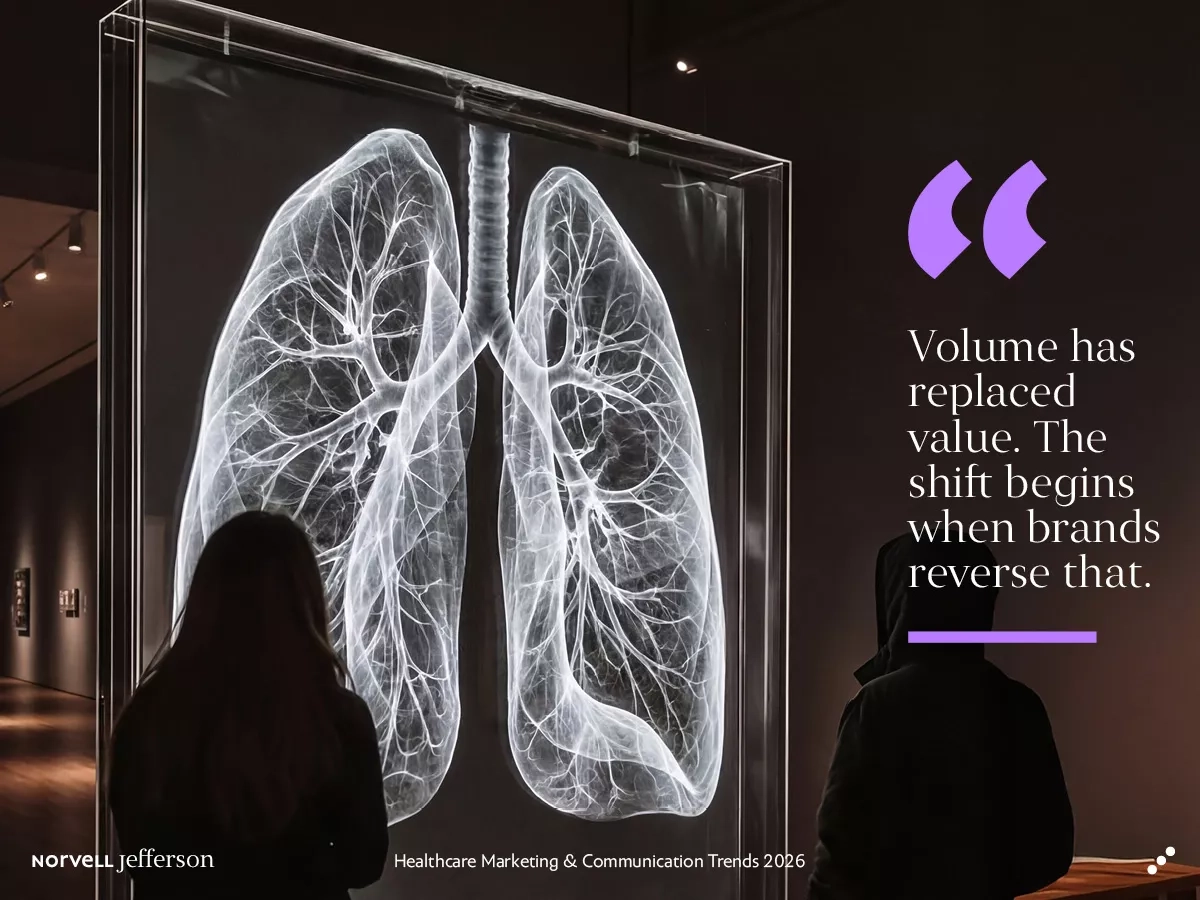
The traditional marketing toolkit is no longer delivering value.
The HubSpot mail chain, the generic brochure, the repetitive sales deck, and another one-hour webinar no longer move the needle. Sales teams struggle to book appointments because people are too busy to read automated emails. Low-value automation has saturated every inbox and feed, training audiences to tune out. Repetition has replaced relevance.
The failure of these static, one-way messages confirms something important: no one will make time for content that does not immediately bring value. The marketing mix does not need another channel or another strategy. It needs to mean something to the person receiving it — and respect the time they do not have.
The problem is not execution. It is assumption. The assumption that more contact produces more trust. It does not. In healthcare especially, where audiences are time-pressured and skeptical by training, every low-value interaction makes the next one harder to earn back.
The brands that are breaking through have stopped optimising for volume. They are optimising for moments people choose to make time for.
Image

High-impact ENGAGEMENT
The strongest communication today is not the most frequent. It is the one people make time for.
That requires a different kind of thinking than most healthcare brands apply today. The question is no longer how to reach more people more often. It is how to create something so useful or so clear that an overscheduled HCP, a skeptical procurement lead, or an overwhelmed patient chooses to engage with it.
An experience is not a format. A webinar or a congress stand is not automatically an experience. What makes something an experience is whether it delivers something the audience could not have gotten elsewhere. A clarity they did not have before. An insight that changes how they think about a problem. A moment that connects evidence to something they recognise as real.
Trust does not build when brands communicate more. It builds when what they deliver is worth the time it takes to engage with it. The technology to reach people already exists. The gap is not reach. It is whether what arrives is worth the attention it asks for.
An experience matters only if it makes something felt.
Image
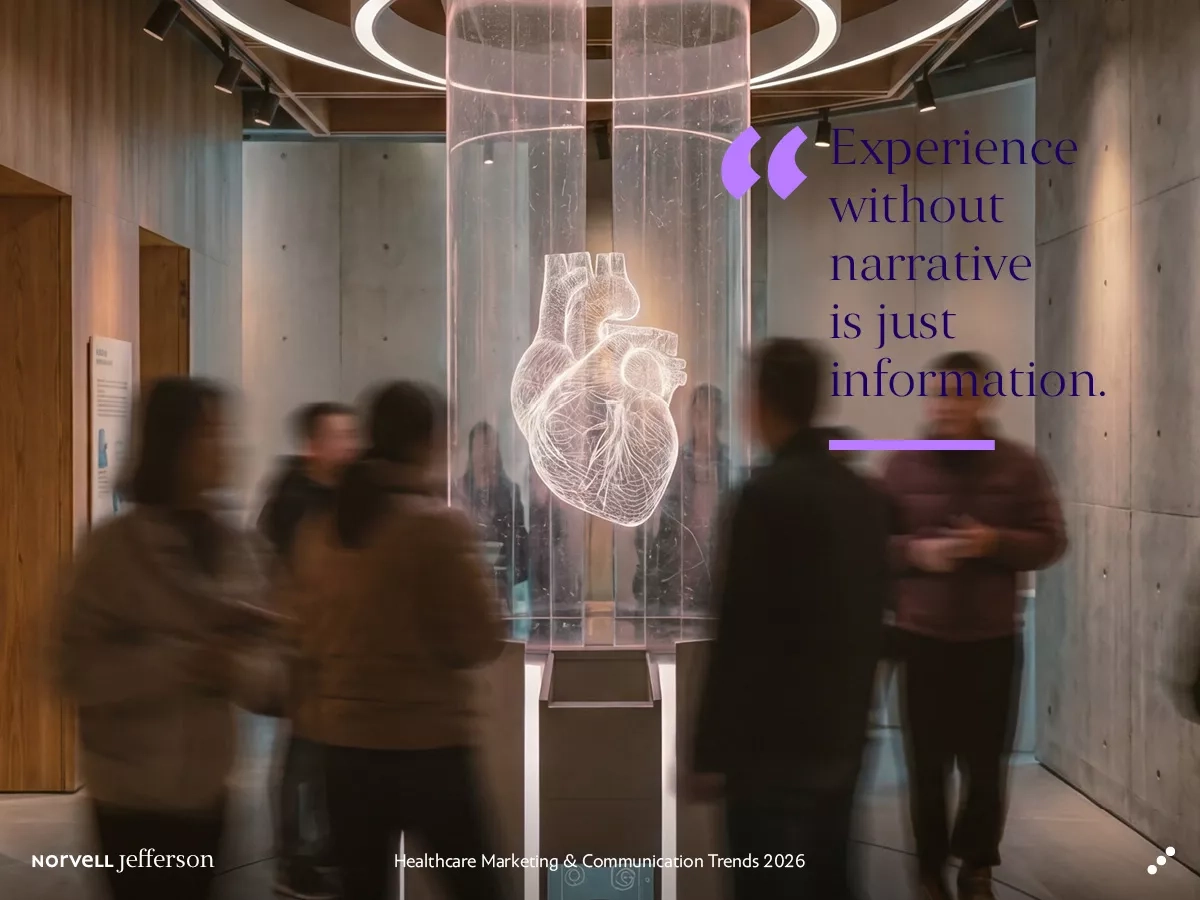
The role of NARRATIVE IMMERSION
Many efforts create the format, but not the experience. The structure is there. The content is accurate. The production is polished. And yet nothing moves.
“Storytelling” is one of the most used words in marketing. And one of the least applied.
Most brands start with the product features and then try to wrap a story around them. That is the wrong order. The story is not packaging for the features. It is what makes the features mean something to the person receiving them. A medtech VR demo without a story is a technical demonstration. A webinar without a narrative arc is a presentation. The format can be immersive. Without narrative, it remains information.
What narrative does is give evidence a reason to matter. It connects a data point to a decision. It shows not just what a product does, but what it changes for a person in a real situation. That is when communication stops being processed and starts being felt.
The shift is not from facts to feeling. It is from reporting outcomes to showing what those outcomes mean in practice. Evidence that is embedded in a story people recognise as real is not less rigorous. It is more useful.
Image
What THE SHIFT actually looks like
The Experience Shift is not a creative brief. It is a change in what communication is expected to do.
Most healthcare communication is designed to inform. The Experience Shift asks for something harder: to create a moment that informs and is felt, that delivers evidence and is remembered, that is compliant and worth making time for.
That does not mean more production value. It means being more precise about what the audience actually needs from each interaction.
Image

From showing to feeling
Most demonstrations show how something works. What people remember is different. They remember the moment something clicked for them. The moment they understood not just what a product does, but what it would change for them. Designing for that moment, rather than for coverage of every feature, is what separates a presentation from an experience.
From monologue to dialogue
The most engaging experiences are not ones where someone presents and others listen. They are the ones where the audience is pulled in. Asked something. Given a choice. Made to respond. Two-way contact changes how people process information. They stop being passive receivers and start being active participants. A webinar where someone asks a question remembers more than one where they sat and watched. A demo where someone makes a decision feels different from one where they observed. The goal is not interaction as a feature. It is participation as a design principle.
From static to immersive
A brochure tells. A calculator lets someone discover. A configurator lets someone choose. The shift from static to immersive is not about technology. It is about giving the audience something to do with the information rather than something to read. When people interact with content, they engage with it differently. They remember it longer. And they trust it more, because they reached the conclusion themselves.
From predictable to imaginative
In a category where every format looks the same, imagination is what breaks the pattern. Not creativity for its own sake, but the deliberate choice to present something in a way the audience has not seen before. A format that surprises earns attention a familiar one never will. And in healthcare, where audiences are trained to filter out the predictable, that attention is worth more than any media budget.
From selling to telling
The sales conversation rarely fails because of lack of information. It fails because it starts in the wrong place. Not with what matters to the person in front of you, but with what needs to be said. The most effective sales conversations work like good stories. They open with something the other person recognises as true about their own situation. They build toward a moment where the solution feels inevitable rather than proposed. Teams that lead with something useful are not less commercial. They are more credible. And more often, they are remembered.
"The Experience Shift is not what happens after the communication strategy is set. It is the communication strategy."
Image

CASES
From interruption to PARTICIPATION
Most healthcare communication interrupts. It arrives uninvited, delivers its message, and leaves. The cases that follow show a different approach. Instead of pushing a message toward an audience, these brands created something the audience chose to engage with. The difference is not the format. It is the intent behind the design.
Image

CASE 01
From information to IMPACT
True engagement happens when a brand stops managing channels and starts curating the quality of the interaction itself. By moving away from one-directional presentations, you create a space, whether a permanent center or a temporary “black box” at a trade show, where complex data is transformed into a shared, tangible reality. This shift allows the audience to move beyond the rational and connect with the brand on an emotional level.
The Future of Healthcare
STORY LIVING
These environments serve as narrative hubs that transition visitors into a physical manifestation of the brand’s story, allowing them to step directly into and become part of the narrative.
Planet Virus
ART MEETS SCIENCE
By replacing clinical clichés with abstract, artistic visuals and animations, brands create an unexpected visual language that makes innovation feel alive rather than static.
The Hospital of The Future
TWO-DIRECTIONAL INTERACTION
True experience is built on participation; using tools like VR, Kinect, or digital questionnaires invites people to do something and become part of the story, sparking meaningful dialogue.
Image
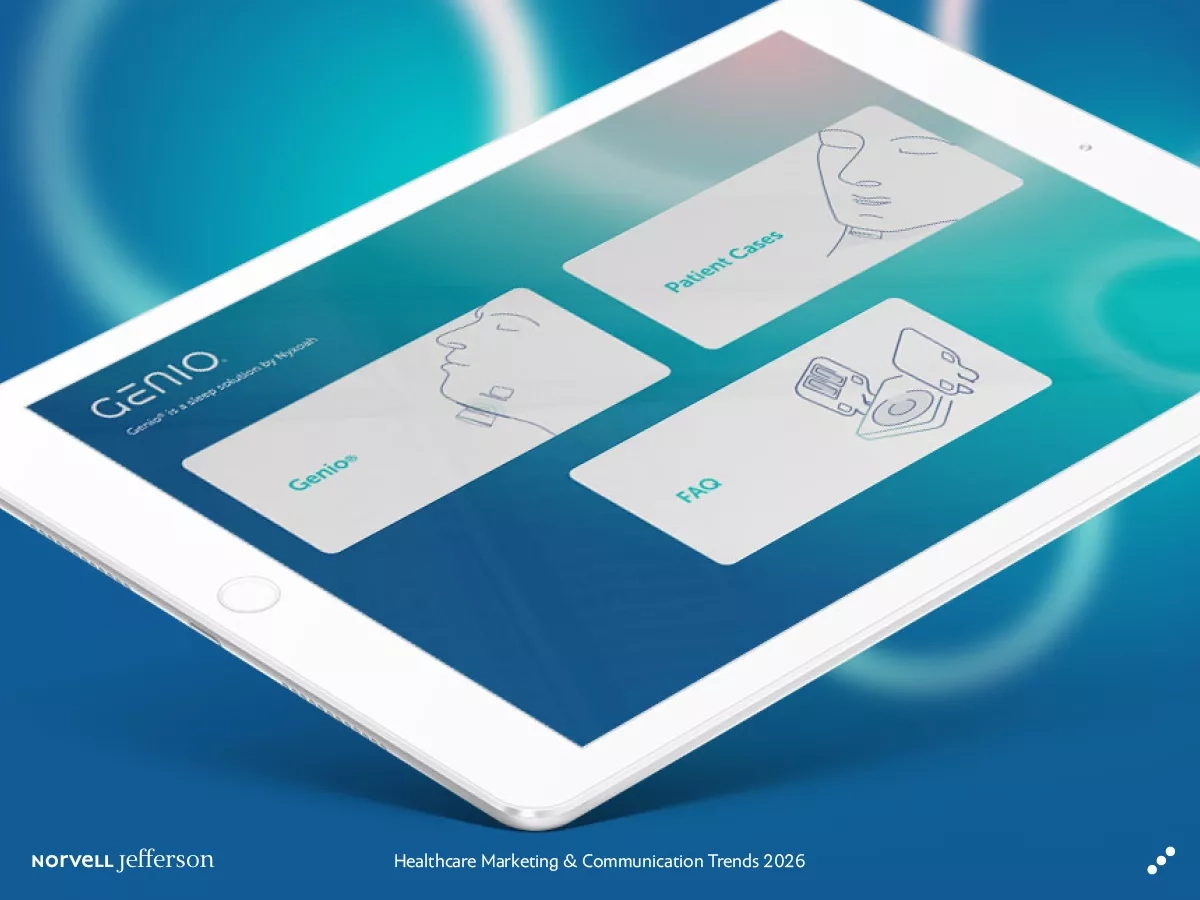
CASE 02
Making the intangible TANGIBLE
VISUALIZING THE INVISIBLE TRIAL
Clinical trial data is often dense and difficult to grasp. By transforming abstract data into an interactive sales story, with guided walkthroughs and real-world comparisons, the results speak for themselves.
THE LAB ON THE GO
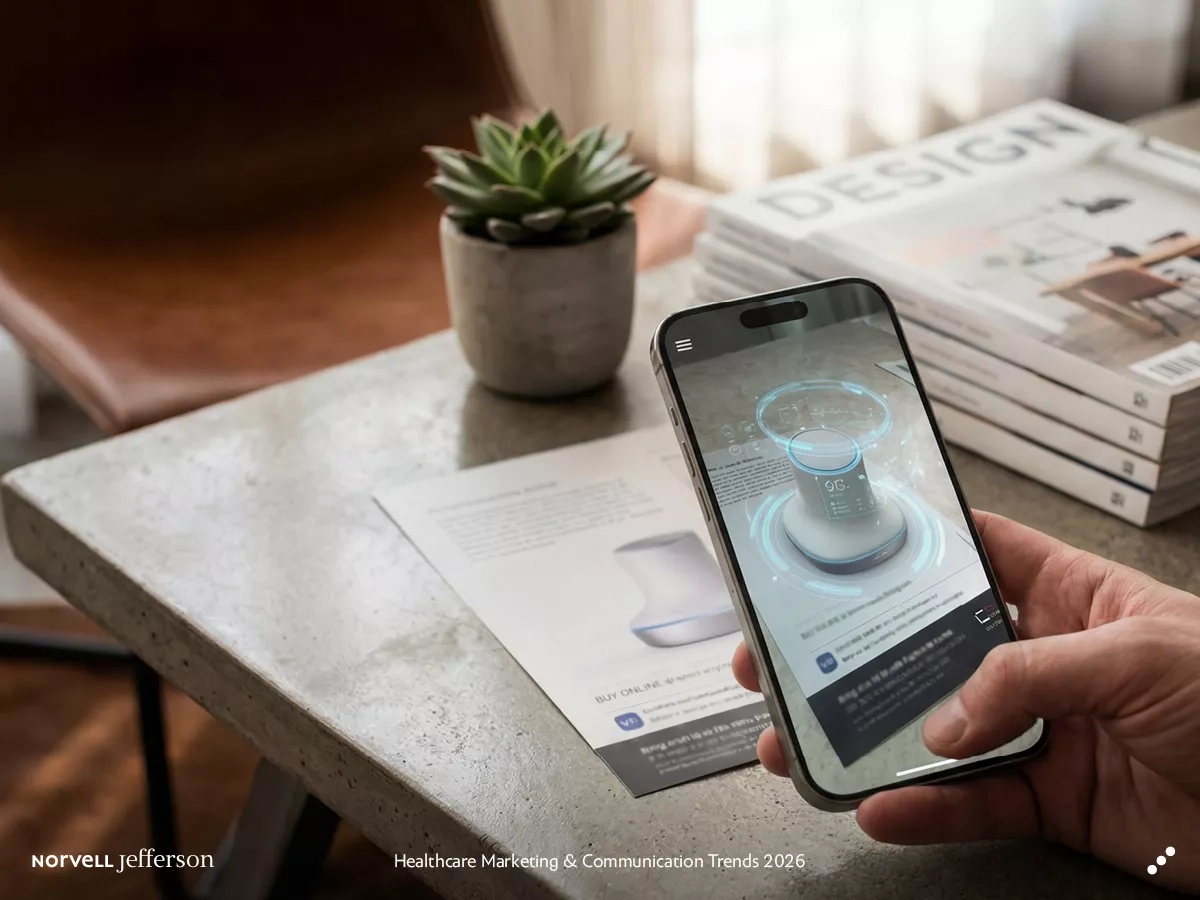
By using Augmented Reality, a leading diagnostics company enabled its sales force to digitally replicate a complex laboratory environment anywhere. Customers can visually explore technical functions and detailed simulations of diagnostic devices, making complex technology instantly accessible and relevant.
Image
CASE 03
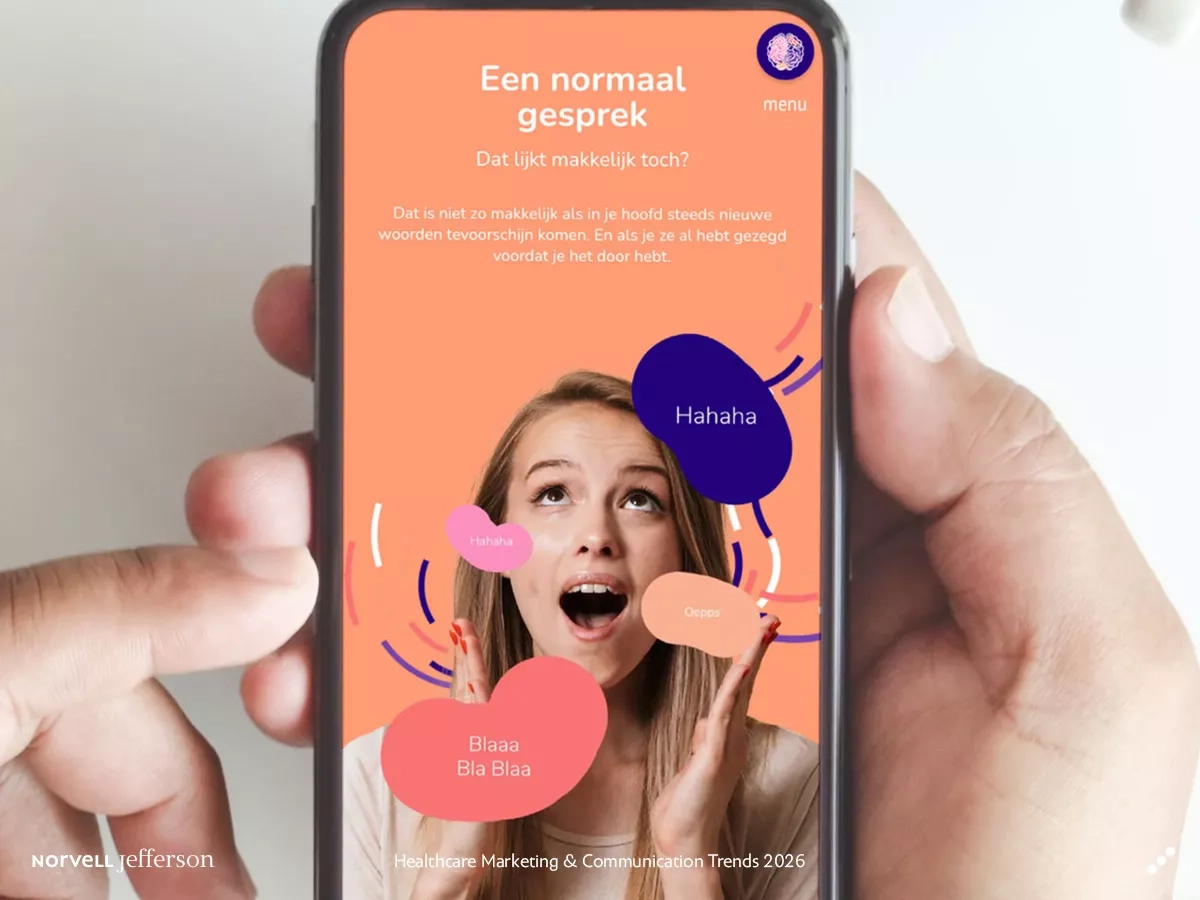
REIMAGINING the patient portal
To truly connect with a young audience, the traditional, text-heavy patient portal was reinvented into an immersive digital experience. Understanding the audience is critical; for those living with ADHD, processing large blocks of text can be an overwhelming barrier.
Recognizing that over-communication is a significant pitfall, the strategy shifted away from dense information toward a visually oriented online world where users can “tune into” the actual feeling of the condition. Before providing facts, the goal was to make them feel something, transforming a static website into a narrative journey.
Cognitive accessibility
By prioritizing a visual-first interface over heavy text, the experience respects the specific needs of the ADHD audience, removing the barriers of traditional patient education to ensure the message actually lands.
Perspective shifting
The scrolling journey uses the online medium to contrast a person’s internal reality with external social interactions, helping the audience understand the condition through feeling and empathy rather than clinical explanation.
Image
Chapter 7: From owned channels to earned influence
The previous chapters showed what it takes to communicate credibly: proof, emotion, transparency, differentiation, relevance, and experience. But even when all of that is right, one question remains. How does it travel? This chapter is about the shift from communication that is pushed outward to influence that moves through trust. And why, in healthcare, the most powerful distribution channel is not one you can buy.
Image

Most healthcare brands still build their communication around channels they own and control. Websites, portals, academies. The assumption is that audiences will come to them.
They will not. Trust has moved. People no longer look to brands for guidance. They look to peers, independent voices, and communities they already belong to. Content from a brand-owned channel is viewed with skepticism. The same message from a trusted peer is not.
This complexity requires a segmented approach:
For professionals
HCPs and researchers have moved their clinical dialogue to high-trust, peer-only networks such as Sermo, Doximity, or their European equivalents. They are not visiting brand sites. They are looking for credible, workflow-relevant content from people who understand their daily reality. Authentic clinical discussion happens in these environments. Brand communication rarely follows them there.
The MedTech complexity
This problem is systemic: MedTech’s centralized approach fails to serve diverse decision-makers. The single, generalized message cannot satisfy the fractured decision-making unit (C-suite needs ROI, procurement needs data, lab managers need specs). Key content remains siloed, missing each audience’s distinct needs.
For patients
Patients validate information through social media, advocacy forums, and LLM-driven search, not centralized portals. What a brand communicates to patients will be checked, shared, and challenged almost instantly. It has to hold up.
Image
Our belief:
TRUST is the new distribution channel
For years, distribution meant reach. The brand that could place its message in front of the most people, most often, held the advantage. But audiences have learned to filter purchased reach. They trust what is shared by people they respect more than what is placed in front of them by brands. Influence no longer sits with brands. It sits with people.
The brands that understand this have stopped asking how to reach more people. They are asking how to become the kind of brand that people choose to share, cite, and return to. That is a different question. And it leads to a different kind of growth.
Image
The challenge of CREATIVE DISTRIBUTION
Buying reach is easy. Earning influence is not.
Most brands understand the direction but struggle with the execution. The content they produce does not feel different from what everyone else is publishing. It is accurate, compliant, and forgettable. It does not give anyone a reason to share it, cite it, or come back to it.
The challenge is not production. It is whether anything is worth sharing. Content travels when it offers something the audience could not have found elsewhere. A perspective grounded in evidence. A clarity that makes decisions easier.
Earned influence also depends on who carries the message. A brand speaking about its own credibility is less convincing than a clinician, a patient, or a peer explaining why something matters in their own words. That only works when the external voice is genuinely free to speak. The moment brand language replaces the authentic voice, the credibility disappears.
Content that cannot be traced to a credible source does not survive.
Image

The earned influence flywheel:
FUELING GROWTH THROUGH TRUST
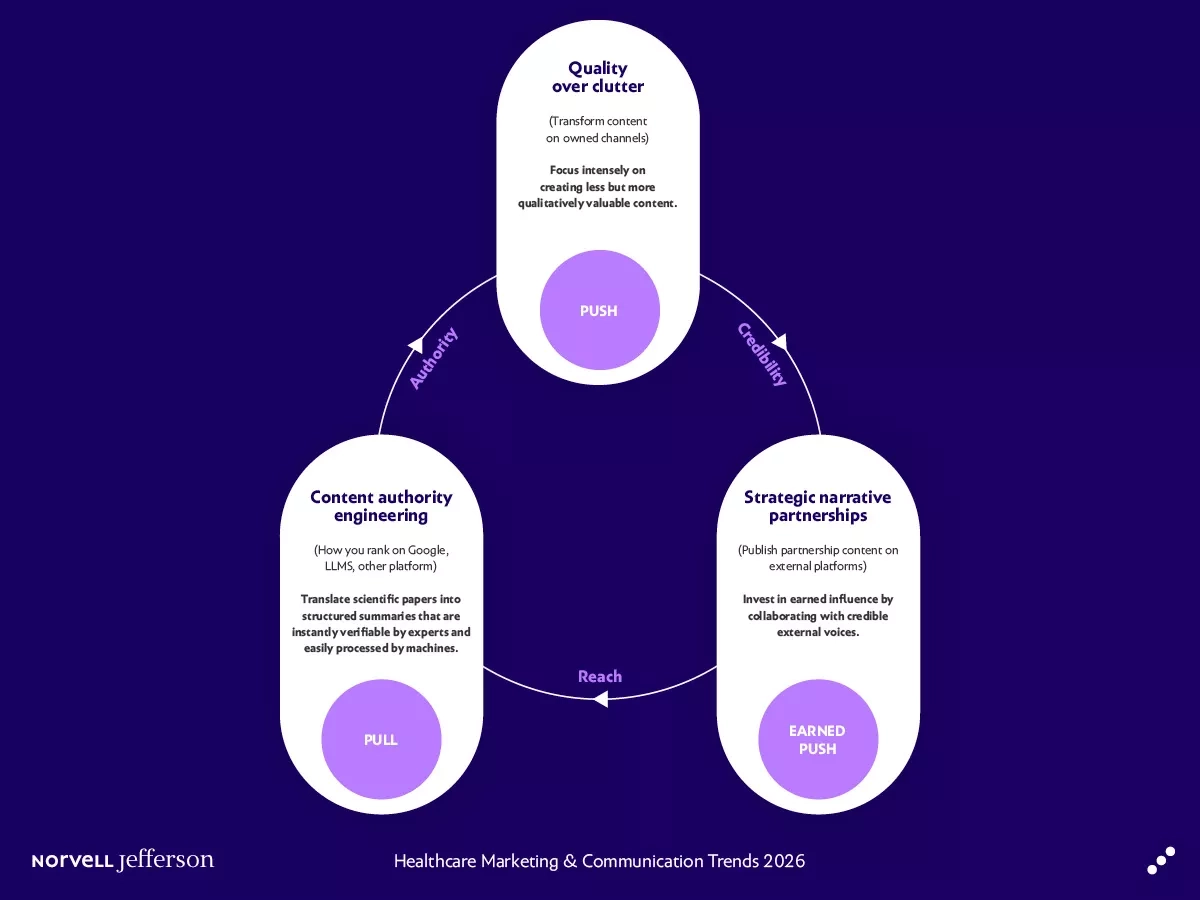
To transition from mere creative distribution to a system of self-sustaining credibility, you need a fundamental shift in strategy. That’s why we engineered a simple, self-reinforcing mechanism we call the Infuelence Flywheel that exists out of three simple actions that build credibility.
The mechanics may look simple, maybe even obvious, but to execute this correctly in a big corporate organization asks for rigorous ownership and dedicated execution. But if you succeed, it will be a self-reinforcing system that grows your brand equity and builds deep trust.
To initiate this process, you must strategically manage three interlocking actions:
01
Quality over clutter
Transform your owned channels by creating less but more qualitatively valuable content, moving your presence from a spam source to a thought leadership hub.
02
Strategic narrative partnerships
Invest in earned influence by collaborating with credible external voices, equipping them with authentic stories that immediately bypass audience skepticism.
03
Content authority engineering
Re-engineer scientific and technical documents into AI-ready, structured summaries that are instantly verifiable by experts and easily processed by machines.
Image
The flywheel in practice
These three elements do not work in sequence. They reinforce each other.
Quality content on owned channels builds the credibility that makes external partnerships possible. Partnerships produce content that earns reach on platforms the brand does not control. That reach drives the searches that surface the structured evidence. The evidence reinforces the quality of the owned content. Each element feeds the next.
This is what makes it different from a content strategy. A content strategy pushes messages outward. The flywheel pulls credibility inward: from external voices, from verifiable evidence, from audiences that return by choice rather than because a paid placement put them there.
Quality over clutter
The action
Your content must be high-quality and instantly relevant—so insightful and valuable that it commands loyalty and contributes real value, rather than becoming another source of digital noise.
Trust transfer
By investing in quality over volume, you transform your owned channel from a clutter generator into a thought leadership hub, earning the basic Trust of Attention that prepares the audience to receive external validation.
Content authority engineering
The action
Structure all valuable content, clinical evidence, expert insights, case studies, and technical documentation, so it is easy to find, easy to verify, and easy to cite. When someone searches for the truth in your field, your source should come up first.
Trust transfer
Well-structured content travels further than content that sits on an owned channel. Every time an expert cites it, a search engine surfaces it, or an AI tool references it, your brand gains credibility it did not have to buy.
Strategic narrative partnerships
The action
Invest in earned influence by collaborating with credible external voices. This involves partnering with patient organizations, clinical leaders, and industry influencers.
Trust transfer
The creative execution must feel real and authentic. The message gains credibility by association, allowing the trust of peer recommendation to be transferred to your content, bypassing audience skepticism.
Image

CONCLUSION
The seven chapters of this report point in the same direction. Not toward a new technique or a smarter strategy. Toward something simpler.
The closer communication stays to reality, the stronger it becomes. That is the pattern running through every chapter. Proof over promises does not just make communication more credible. It makes it more scientific and less like marketing.
When evidence is connected to what it means for the people affected by it, something else happens. It becomes emotional. Not because emotion was added, but because it was already there in the reality behind the data.
Transparency works the same way. The more clearly a brand shows how things actually work, the less it needs to claim authenticity. It simply becomes authentic. Not as a brand value. As a consequence of how it communicates.
The same logic runs through the rest. Sameness is what happens when communication drifts away from reality, when brands copy each other instead of expressing what they actually do.
Relevance is what happens when communication reflects the real situation of the person receiving it. Experience lands when it is built around a real moment that matters. And influence is earned when the reality behind a brand is strong enough that others choose to share it.
This is not a framework. It is an observation about how trust actually works. The brands that will lead in healthcare are not the ones that communicate more, or louder, or more creatively. They are the ones that stay closest to what is real, in their evidence, in their stories, in how they show up at every point of contact.
Reality, clearly communicated, is what earns trust. Everything else is noise.
Find out more
Image

case
LivaNova Cardiopulmonary - product rebranding
We launched a campaign showcasing LivaNova’s Essenz Perfusion System and its role in advancing cardiac surgery. Through bold storytelling, we highlighted their innovation and strengthened brand recognition.
The campaign reinforced LivaNova’s leadership and drove growth in innovation.
Video file
case
BD Kiestra - product launch campaign
We helped BD move from technical product marketing to emotionally engaging storytelling. The campaign made automation relatable and strengthened BD’s role in diagnostic innovation.
The campaign boosted BD’s visibility and reinforced its leadership in microbiology.
Video file
case
Takeda - ADHD disease awareness
Experience ADHD from the inside out. Our innovative 'vision flip' approach bridges understanding, bringing those with ADHD and their loved ones closer together. See ADHD through a new lens.
Image
case
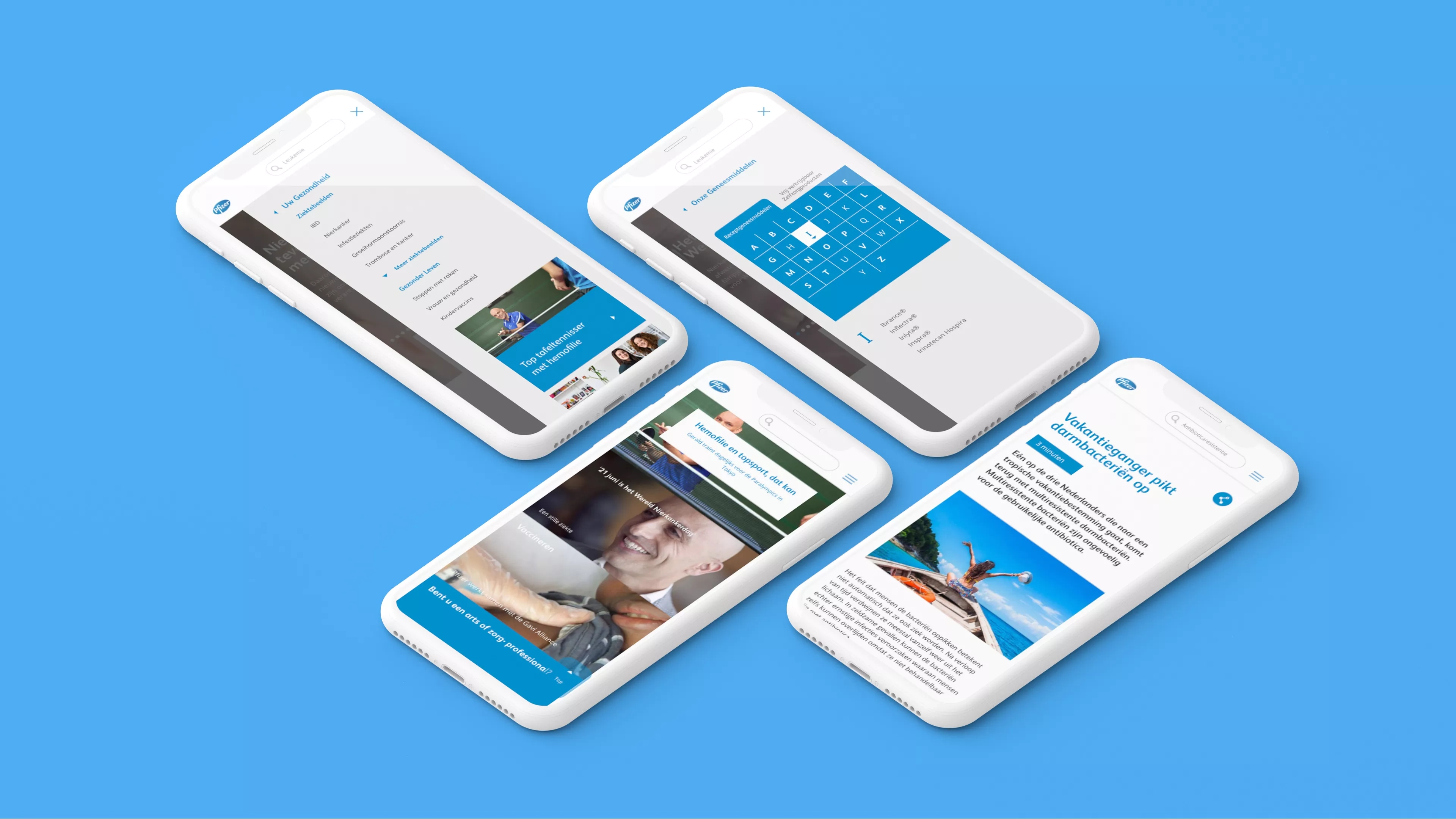
Pfizer - website design
With Pfizer, we reimagined healthcare storytelling—humanizing content for consumers and professionals through evocative videos and imagery. The new Pfizer.nl combines modern design with emotional stories that connect and inspire.
Video file
case
Sakura SmartConnect - product launch campaign
We launched S.A.R.A., turning a technical innovation into a relatable story with a human touch. Through storytelling, the campaign built trust and connected Sakura with lab professionals.
The launch made S.A.R.A. a memorable innovation in pathology labs.