Video file
Image

Best AgriFood marketing campaigns: 8 client cases that made innovation matter
Best AgriFood Marketing Campaigns and Branding Examples: 8 Client Cases (2026)
Summary
Best AgriFood Marketing Campaigns and Branding Examples: 8 Client Cases (2026) showcases how leading AgriFood brands turn complex innovation into clear, distinctive and relevant stories. From AgTech branding and sustainable agriculture to food innovation, product launches and corporate transformation, these cases demonstrate how strategy and creativity can connect technical expertise with real-world value. Together, they show how strong AgriFood marketing makes innovation easier to understand, builds trust across audiences and turns ambitious ideas into meaningful action.
Summary
Best AgriFood Marketing Campaigns and Branding Examples: 8 Client Cases (2026) showcases how leading AgriFood brands turn complex innovation into clear, distinctive and relevant stories. From AgTech branding and sustainable agriculture to food innovation, product launches and corporate transformation, these cases demonstrate how strategy and creativity can connect technical expertise with real-world value. Together, they show how strong AgriFood marketing makes innovation easier to understand, builds trust across audiences and turns ambitious ideas into meaningful action.

Olivia Taylor
Content Marketeer
The best AgriFood marketing campaigns do more than explain a product. They make complex innovation easier to understand, connect it to the decisions people make every day, and give audiences a credible reason to change.
That is difficult in a sector shaped by science, regulation, long value chains and competing pressures. Farmers need practical value. Technical experts need proof. Commercial teams need a clear proposition. Investors need to understand the opportunity. Consumers and society increasingly expect evidence behind claims about sustainability, safety and impact.
This selection brings together eight campaigns and branding projects created by Norvell Jefferson for organisations across AgTech, animal nutrition, biologicals, dairy, food ingredients and circular food systems. We have deliberately focused on our own work. Not because these are the only AgriFood campaigns worth studying, but because these are the cases we can examine from the inside: the original challenge, the strategic choices, the creative development, the activation and, where available, the results.
It is not an awards ranking. It is a practical review of how brands turned technical propositions into ideas that farmers, customers, partners and investors could recognise and use. The cases also reveal wider trends shaping AgriFood marketing in 2026: proof over promise, humanising technology, making sustainability tangible, and building brands around what is genuinely true.
The campaigns at a glance
Select a campaign to jump to the full case.
- Trouw Nutrition Sprayfo Ultimo: Empower Every Calf (Animal nutrition product launch)
- Cargill Dairy Enteligen: The Farmer's Vision in Motion (AgTech product launch)
- Elicit Plant: Triggering the Power Within (AgTech brand repositioning)
- Aphea.Bio: The Underground Revolution (Biologicals branding)
- Biotalys: Reinventing Food Protection (Agri-biotech branding and market introduction)
- Duynie: Celebrating the Power of Upcycling (Upcycled solutions campaign)
- Interfood: The Evolution of a Dairy Brand (B2B food rebranding)
- Nutreco Trouw Nutrition: Small Switches. Big Change. (Antimicrobial resistance awareness campaign)
How we selected these AgriFood marketing examples
A distinctive visual is not enough. Each case in this list was assessed against five questions:
- Was the idea grounded in a real AgriFood challenge? The work needed to address a practical pressure, market barrier, scientific proposition or behaviour that mattered to the audience.
- Did it make complexity clearer? The campaign or brand needed to translate technical information without reducing it to an unsupported slogan.
- Was the relevance specific? Strong AgriFood communication reflects the reality of farmers, nutritionists, producers, buyers, partners or investors rather than speaking to an abstract market.
- Was the idea distinctive and ownable? The central expression needed to grow from something true about the organisation, product or technology.
- Could it work in the real commercial environment? The idea needed to support launches, sales conversations, digital content, events, investor communication or local activation without losing its meaning.
Together, the cases show a broader shift in AgriFood marketing. More information does not automatically create more confidence. Communication becomes stronger when proof is understandable, sustainability is specific, and innovation is connected to a real decision in the field, the factory, the laboratory or the boardroom.
01. Trouw Nutrition Sprayfo Ultimo: Empower Every Calf
Sprayfo Ultimo entered the market with an ambitious proposition. Its value was not limited to calf milk performance in the first weeks of life. Strong early nutrition could contribute to healthier, more resilient herds and a more productive and sustainable dairy operation over time.
The challenge was to turn that long-term value into a product launch that farmers across different markets could immediately recognise. A list of nutritional features would explain what the product contained. It would not explain why the first stage of a calf's life matters to the future of the entire farm.
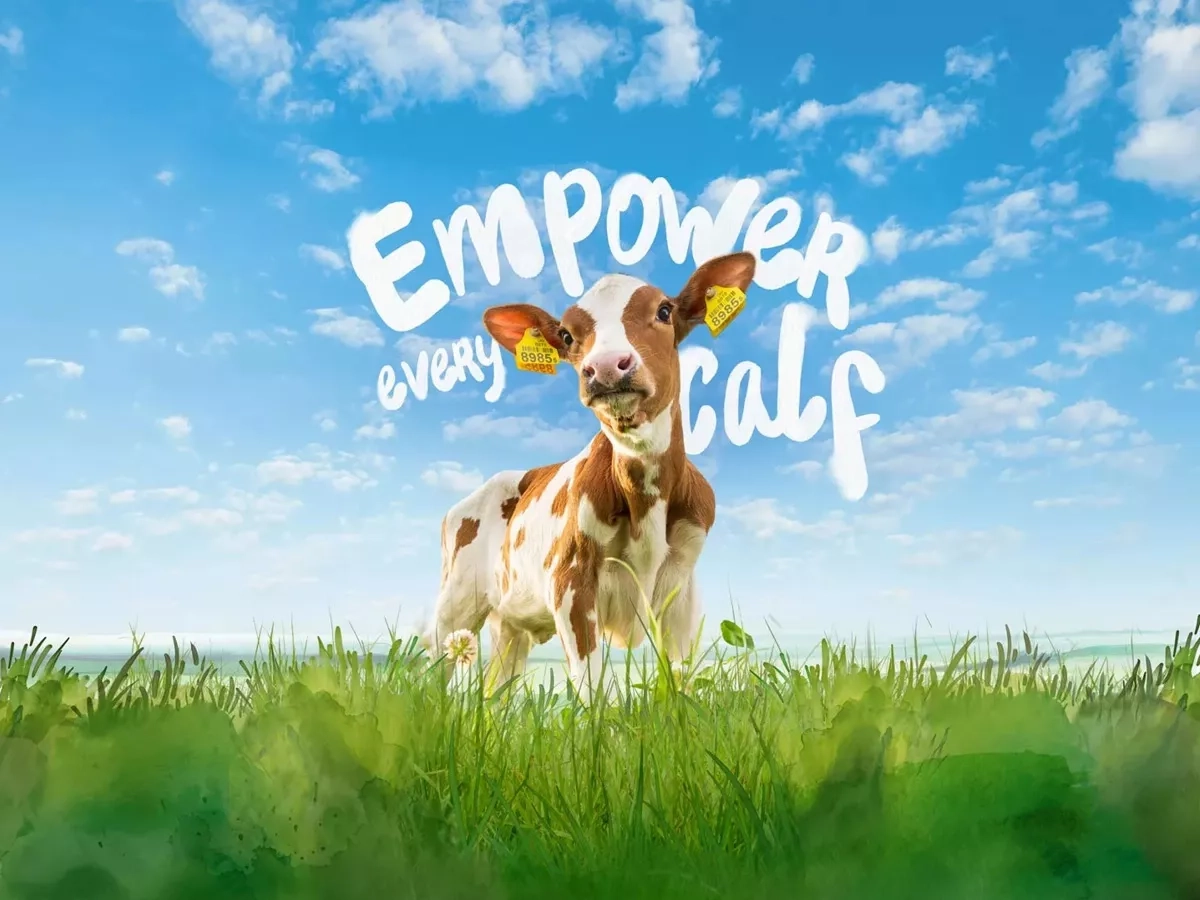
The campaign was built around one direct idea: Empower every calf. It positioned each calf as the beginning of a wider outcome. Better early development creates potential for the animal, the herd and the dairy business.
The creative expression combined live-action footage with watercolour animation. The visual language connected advanced nutrition science with nature and growth. Calves addressed farmers directly, giving the story a personal point of view without losing the product's practical relevance.
The launch extended across film, animation, key visuals, photography, infographics, print, social content, a landing page and an interactive event experience. It began with teaser activity at EuroTier, where visitors encountered the campaign through visuals, animation and augmented reality, before the platform was adapted for local markets.
Why it worked:
The campaign gave a technical product a clear role in the farmer's bigger ambition. It made the long-term value of early nutrition visible through one animal and one memorable promise.
The lesson for healthcare marketers:
When the benefit develops over time, show the chain of consequence. Connect the immediate product decision to the future outcome the audience is trying to build.
View the Trouw Nutrition Sprayfo Ultimo product launch View all case studies.
Image
02. Cargill Dairy Enteligen: The Farmer's Vision in Motion
Data platforms in agriculture are often communicated through dashboards, efficiencies and technical capabilities. Those details matter. But they can leave the farmer outside the story, as if the technology itself makes the decision.
Cargill Animal Nutrition wanted to introduce Dairy Enteligen as a data-driven platform that helps farmers make better decisions today while preparing their operations for the future. The campaign needed to express a bold AgTech vision without losing the human reality of farming.
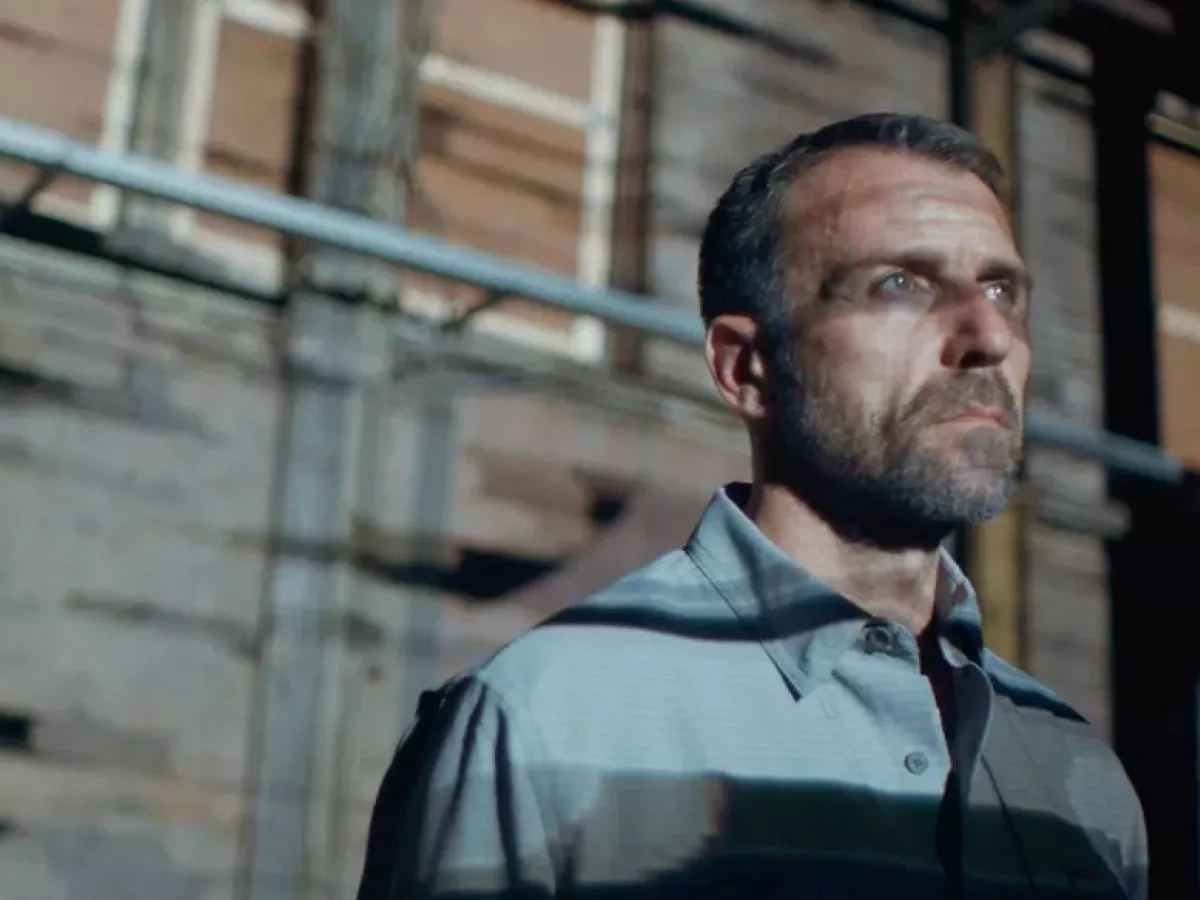
The concept placed the farmer at the centre. He reflects on the future of his farm while data moves around him as a visible, fluid presence. The technology does not replace his knowledge. It strengthens his ability to act on it.
To create that world, the film was shot on a real farm using live projections. Dynamic data was projected directly onto the agricultural environment rather than added as a conventional interface afterwards. The effect made the relationship between digital insight and physical reality immediate.
The idea also broke with familiar AgTech imagery. Instead of another sequence of screens, aerial farmland and generic innovation claims, the campaign created a distinctive visual metaphor grounded in the farmer's perspective.
Why it worked:
It made data tangible without making the technology the hero. The farmer remained responsible for the vision and the decision. Enteligen became the intelligence that helps move that vision forward.
The lesson for healthcare marketers:
Technology becomes meaningful when audiences can see the role it plays in their judgement, risk and future. Do not communicate data as an abstract asset. Show the decision it improves.
View the Cargill Dairy Enteligen AgTech campaign View all case studies.
Image
03. Elicit Plant: Triggering the Power Within
Elicit Plant had patented phytosterol-based technology, a growing international presence and a clear scientific proposition. What it needed was a brand platform capable of carrying that value across markets without allowing the science to become either inaccessible or generic.
The strategic opportunity came from the technology's mode of action. Elicit Plant does not simply respond after climate stress has damaged a crop. Its technology activates natural processes within the plant, helping improve water-use efficiency and resilience before the stress occurs.
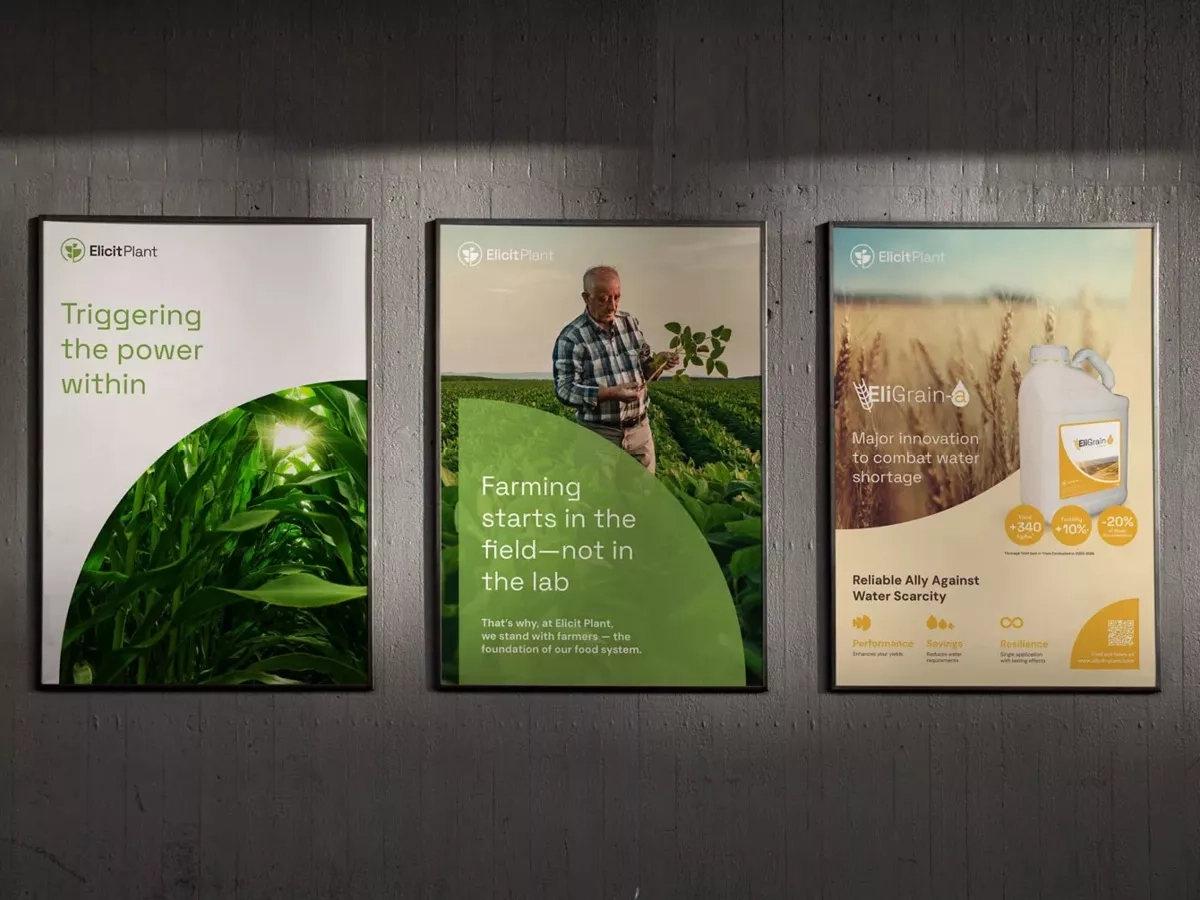
That truth became the organising idea: Triggering the power within.
The statement works because it is not only a metaphor. It reflects the biology behind the proposition. Phytosterols act as the trigger. The plant's own internal potential becomes the source of resilience. This moved the brand from a broad story about crop protection into a more distinctive space: preventive preparation from within.
The repositioning was translated into a complete brand toolbox, including messaging, logo architecture, colour and typography systems, graphic elements, illustration and photography guidance, templates and governance rules. The system was designed to work across sales materials, packaging, presentations, digital platforms and international communications.
Why it worked:
The brand idea simplified the scientific mechanism without separating itself from the science. It gave Elicit Plant a clear position that competitors could not use with the same credibility.
The lesson for healthcare marketers:
The strongest brand platform may already exist inside the technology. Look for the mechanism, behaviour or outcome that is both scientifically true and strategically distinctive.
View the Elicit Plant brand repositioning View all case studies.
Image
04. Aphea.Bio: The Underground Revolution
Aphea.Bio was using advanced biological science to challenge long-established agricultural practices. The company needed more than a polished identity. It needed a value proposition and brand story that could distinguish the business, communicate its ambition and support an important investor conversation.
The strategic work identified courage as a defining truth. The organisation was not simply improving an existing category. It was taking a different route to healthier crops, enriched soil and more sustainable agricultural productivity.
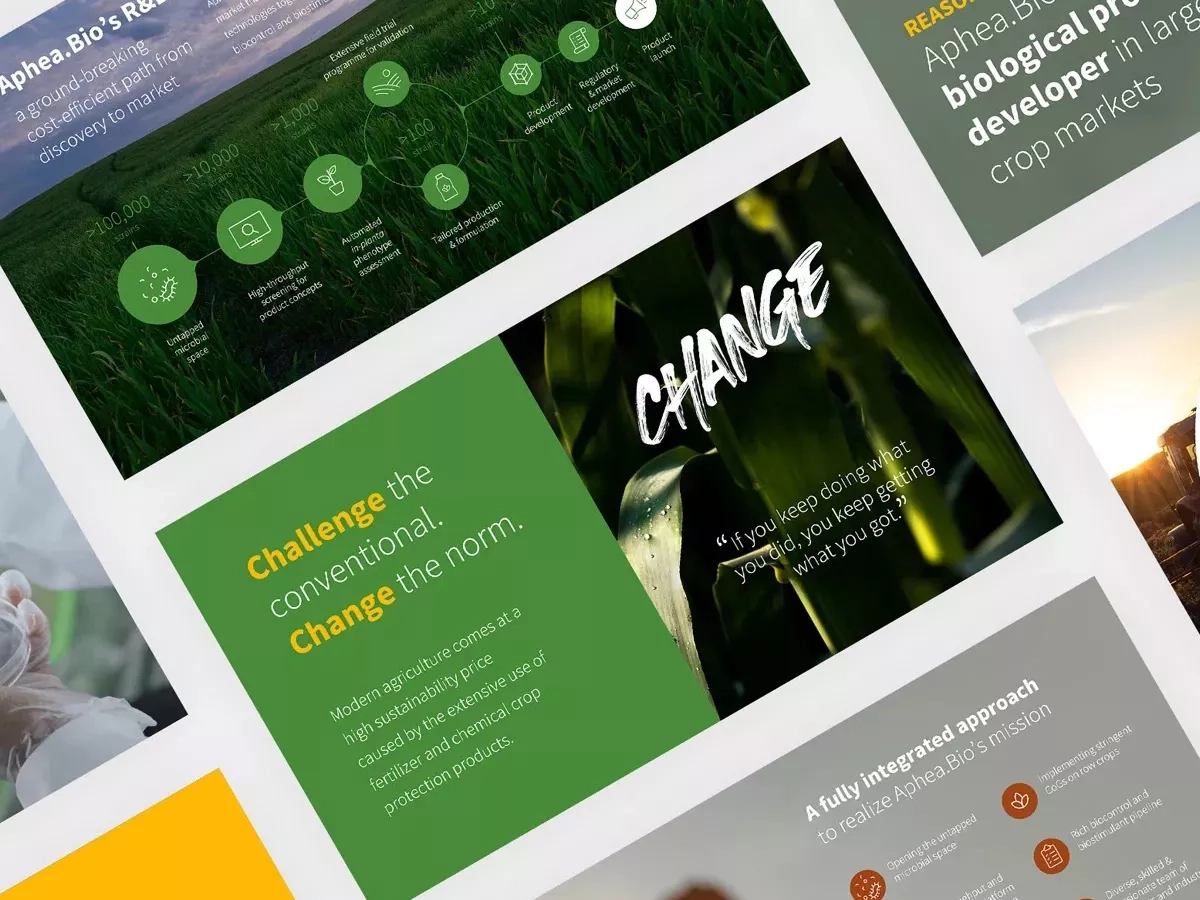
That led to a brand world built around The Underground Revolution. The phrase connected the scientific work happening below the surface with the company's willingness to challenge convention above it.
The identity used the language of change and revolution, but grounded it in the reality of biological innovation. The work included a refreshed logo, new colour system, photography, website, corporate video, brochure and investor pitch deck. Strategy and execution were completed within six weeks, giving the company a coherent platform for its next fundraising stage.
Why it worked:
The brand gave a highly technical business a clear point of view. It did not present biologicals as a quieter version of conventional agriculture. It positioned them as a different way forward.
The lesson for healthcare marketers:
Investors and customers need more than the science itself. They need to understand the change the science makes possible, the belief driving the organisation and why the company is equipped to lead it.
View the Aphea.Bio branding case View all case studies.
Image
05. Biotalys: Reinventing Food Protection
Before becoming Biotalys, the company had spent years developing a protein-based biocontrol platform under the name Agrosavfe. As it prepared to enter the market, the science was strong but the external story was still heavily technical.
The communication challenge was to make the proposition understandable and relevant across a broad group of stakeholders. Growers, partners, investors and the wider food system needed to see not only how the technology worked, but why it represented a meaningful alternative.
The brand shifted from product thinking to purpose thinking. Protein-based biocontrols were positioned within a wider ambition: protecting crops against pests and diseases while supporting safety for the environment, the farmer and the consumer.
The narrative was captured through a sequence of clear statements: New ground. New standard. Safer food. Better planet. The new name and identity created a market-ready platform around the idea of reinventing food protection from farm to fork.
The work included naming, logo design, visual identity, website design and development, a product launch film, advertising, social content and brochures.
Why it worked:
The brand translated specialist science into a benefit structure different audiences could understand. It retained technical credibility while creating a clearer role for the company in the food system.
The lesson for healthcare marketers:
Simplification should not remove the science. It should organise it around the value each audience needs to recognise. Start with the shared purpose, then provide the technical depth that proves it.
View the Biotalys branding and market introduction View all case studies.
Video file
06. Duynie: Celebrating the Power of Upcycling
Duynie turns sidestreams from food production, including ingredients derived from potatoes, grains and corn, into useful solutions for applications ranging from pet food to biogas. The process is commercially valuable and environmentally relevant. It is also difficult to explain without quickly disappearing into technical detail.
The campaign needed to show what upcycling means, why the ingredients matter and how the model contributes to a more circular food system. The creative challenge was to make the transformation memorable without presenting sustainability as an abstract claim.
The idea was to build an imaginative world around Duynie itself. In that world, materials commonly described as waste become the starting point for something new. The brand sits at the centre of the transformation, turning overlooked sidestreams into opportunity.
A digitally produced stop-motion style gave the work a tactile, handcrafted quality. Playful animation simplified the process while retaining the substance of the story. The main film was supported by social media adaptations that allowed individual parts of the upcycling narrative to travel further.
Why it worked:
It made circularity visible as a process. The campaign did not only state that Duynie reduces waste. It showed the moment in which waste changes meaning and value.
The lesson for healthcare marketers:
Sustainability communication becomes stronger when audiences can see the mechanism. Replace broad environmental language with a specific transformation, system or behaviour that can be understood and verified.
View the Duynie upcycled solutions campaign View all case studies.
Image

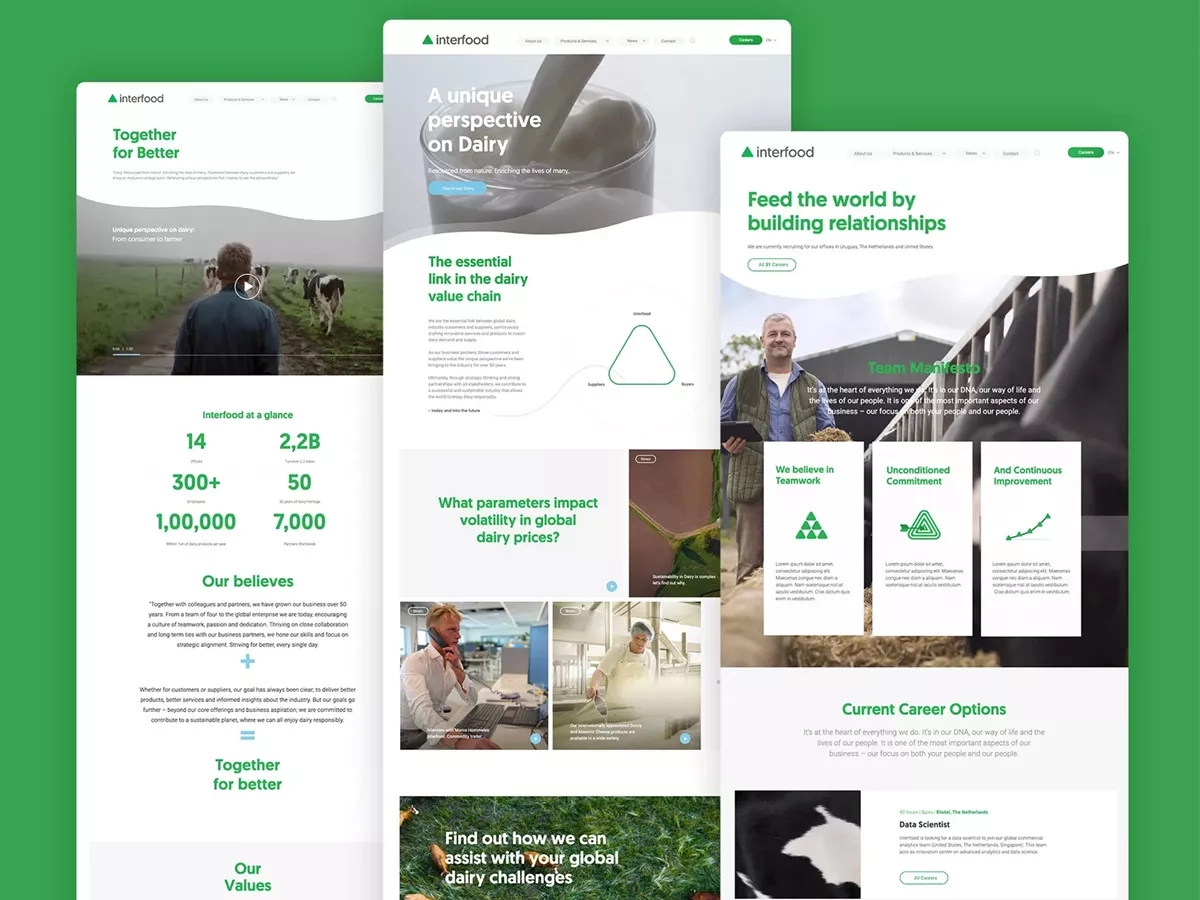
07. Interfood: The Evolution of a Dairy Brand
After fifty years in the dairy industry, Interfood was moving toward a broader strategic role. Its future was not only about trading dairy ingredients. It was about creating value through partnership, expertise and a long-term sustainability journey across People, Planet, Partnership and Prosperity.
The challenge was to communicate that transition without disconnecting the company from the heritage and credibility it had built. Sustainability also had to be treated honestly. Real transformation takes time, and a credible narrative cannot suggest the journey is already complete.
The repositioning shifted Interfood from a traditional trader toward a solutions provider capable of opening new perspectives for customers. The brand story used the company's history as a foundation while creating space for its future ambition.
A new visual language expressed that idea through different perspectives. The work was translated into a brand story book, communication strategy, identity, website, brand film, value animation, corporate presentation and a new private-label brand, Kalla.
Why it worked:
The rebrand did not erase the past to make the organisation appear new. It used fifty years of experience as proof that Interfood had the knowledge and relationships to lead its next chapter.
The lesson for healthcare marketers:
A sustainability transition should be communicated as a direction supported by action, not as a finished claim. Credibility grows when the brand is clear about where it comes from, where it is going and what still needs to change.
View the Interfood B2B dairy rebrand View all case studies.
Image
08. Nutreco Trouw Nutrition: Small Switches. Big Change.
Antimicrobial resistance is one of the largest public-health and food-system challenges facing the world. Within animal production, awareness of the need to reduce antibiotic use is growing. The practical difficulty is knowing where to begin and how to turn a global problem into manageable action.
Trouw Nutrition had developed a programme to support more responsible antibiotic use. The campaign needed to move the conversation from why change is necessary to how change can happen.
The central idea was Small switches. Big change. It reframed the issue around a series of practical improvements that can be switched on across the production system. No single action solves antimicrobial resistance. Many informed decisions, repeated and combined, can move the industry forward.
The campaign created a global visual language representing stakeholders across the value chain. The concept was translated into a messaging framework, key visuals, sales materials, infographics, a landing page and local marketing support, enabling teams in different markets to activate the same platform.
Why it worked:
It respected the scale of the problem without making the audience feel powerless. The campaign turned urgency into a clear sense of agency.
The lesson for healthcare marketers:
When the challenge is too large for one message or one action, show the pathway. Make progress specific enough that people can understand their role in it.
View the Nutreco Trouw Nutrition AMR awareness campaign View all case studies.
Image

What the best AgriFood marketing campaigns have in common
These cases cover different audiences, markets and creative disciplines. The pattern beneath them is consistent.
They start with the audience's real decision
The strongest work does not begin with what the organisation wants to announce. It begins with what someone needs to understand or decide.
A dairy farmer is deciding how to build a more resilient herd. A grower needs to understand the practical value of a biological technology. An investor needs to see the scale and credibility of a new category. A food-industry partner needs to understand how circularity creates both environmental and commercial value.
That real decision gives the communication its relevance.
They make science usable
AgriFood innovation often depends on complex mechanisms, data and systems. Elicit Plant translated phytosterol action into preventive resilience from within. Biotalys organised protein-based biocontrol around safer food and a better planet. Cargill showed how data supports a farmer's judgement rather than replacing it.
The creative idea does not compete with the science. It gives the science a form people can remember and apply.
They turn sustainability into something specific
Sustainability is too broad to function as proof. Duynie shows a material being upcycled. Interfood communicates an ongoing transition rather than a completed achievement. Nutreco Trouw Nutrition breaks a systemic problem into achievable switches.
The strongest sustainability stories show what changes, how it changes and who is responsible for making it happen.
They give technology a human consequence
Technical communication often assumes rational value will speak for itself. It rarely does. Sprayfo Ultimo connected early nutrition to the future of the herd. Dairy Enteligen connected data to the farmer's vision. Aphea.Bio connected biological innovation to the courage to change an established system.
The human context is not decoration. It is what makes the proposition relevant.
They are distinctive because the difference is real
A brand can copy a visual trend. It cannot copy a scientific mechanism, company history or operating model that is not true for it.
The power within belongs to Elicit Plant's mode of action. The underground revolution belongs to Aphea.Bio's biological mission. Duynie's world of transformation belongs to its upcycling process. Interfood's evolution belongs to fifty years of dairy experience.
Distinctiveness becomes durable when it grows from reality.
They create value beyond exposure
An effective AgriFood campaign should do more than generate views. It can improve understanding, support adoption, strengthen sales conversations, align international teams, build investor confidence or make a behaviour easier to change.
Reach shows that communication arrived. Value shows that it mattered.
Frequently asked questions about AgriFood marketing campaigns
What are some examples of successful AgriFood marketing campaigns?
Examples include Trouw Nutrition's Empower Every Calf, Cargill Dairy Enteligen's The Farmer's Vision in Motion, Elicit Plant's Triggering the Power Within, Aphea.Bio's The Underground Revolution, Duynie's upcycling campaign and Nutreco Trouw Nutrition's Small Switches. Big Change. Each case uses a different approach, but all translate complex innovation into something farmers, customers, partners or investors can understand and act on.
What makes an AgriFood marketing campaign effective?
An effective AgriFood campaign combines a real audience tension, credible evidence, a clear organising idea and a useful next step. It should connect technical value to a practical decision without oversimplifying the science or relying on broad claims.
How can AgriFood brands make complex science easier to understand?
Start with the consequence rather than the full mechanism. Show what the technology changes for the crop, animal, farmer, producer or food system, then make the evidence available at the level of detail each audience needs. Visualisation, animation, analogy and real-world demonstration can all help, provided they remain accountable to the science.
How can AgriFood brands communicate sustainability without greenwashing?
Avoid presenting sustainability as a personality trait. Show the specific process, behaviour, investment or measurable change behind the claim. Be clear about what has already been achieved, what is still in progress and where evidence can be checked. A credible transition story is stronger than a polished image of perfection.
How should AgriFood campaigns be measured?
Start by moving beyond vanity metrics. Impressions, video views and clicks can indicate soft awareness, but they do not show whether a campaign improved understanding, supported a commercial decision or changed behaviour. Measurement should follow the campaign's purpose and connect attention to meaningful outcomes such as qualified engagement, distributor or farmer uptake, sales enablement, lead quality, event participation, resource use, partner alignment, investor response or adoption.
How long should an AgriFood campaign run?
There is no universal duration. A product launch may have a concentrated period around an event or market introduction. Brand repositioning, category education, sustainability communication and behaviour change require a sustained platform. The audience should encounter consistent evidence and useful content long after the first campaign flight ends.
About this selection
This article deliberately focuses on AgriFood campaigns and branding projects created by Norvell Jefferson. We selected our own work because these are the cases we can examine from the inside: from the original challenge and strategic choices to creative development, activation and, where available, measurable results.
This is not intended as a definitive global ranking or a sponsored comparison. It is a curated selection showing different ways to make complex AgriFood innovation clear, relevant and memorable.
Last updated: July 29, 2026
Build an AgriFood brand people can believe
AgriFood audiences do not need another broad promise about innovation or sustainability. They need communication that stays close to the evidence, respects the reality of their decisions and makes the value clear.
Norvell Jefferson helps AgTech, animal nutrition, food and agricultural organisations turn complex science into brands, campaigns and experiences that people can understand, remember and act on.
Talk to our AgriFood marketing team View all case studies.
Olivia Taylor
Content Marketeer
Find out more

article
HIMSS 2025 - Connecting Intelligence
The healthcare industry is experiencing a fundamental transformation, where technology is no longer just a support function—it is becoming the backbone of healthcare operations, decision-making, and patient care. At HIMSS25, it became clear that AI, interoperability, and cybersecurity are not just industry buzzwords; they are rapidly shaping the future of healthcare. For actionable insights, explore our detailed HIMSS 2025 Marketing Insight Report.

article
Vitafoods 2025: Trends shaping the future of Nutraceutical marketing
Vitafoods Europe 2025 spotlighted a nutraceutical industry in transformation, where supplements are no longer confined to capsules but are becoming part of daily routines through food format, flavor-driven experiences. Key themes included the shift from pills to prototypes, the elevation of science from proof to narrative, and a renewed focus on in-person connection as the heart of brand engagement. The event emphasized credibility, taste, and storytelling as the building blocks of relevance in today’s B2B health landscape.

article
BIO 2025 – Biotech at a Turning Point
BIO 2025 brought together over 20,000 leaders across the global life sciences ecosystem. This report explores the big themes that emerged, from AI as infrastructure to a new era of biotech branding, and what they mean for marketers, communicators, and innovators shaping the future of health.
Video file
case
argenx - branding
We partnered with argenx to craft a distinctive brand, rooted in authenticity and simplicity, telling their true and authentic story. This involved logo redesign and a global style guide to ensure brand consistency. Additionally, we developed a new website and produced a brand video. These efforts played a pivotal role in fueling argenx's remarkable journey of growth and success.
Video file
case
Sakura SmartConnect - product launch campaign
We launched S.A.R.A., turning a technical innovation into a relatable story with a human touch. Through storytelling, the campaign built trust and connected Sakura with lab professionals.
The launch made S.A.R.A. a memorable innovation in pathology labs.
Video file
case
Health House
Our strategic approach transformed pandemic discussions into comprehensive, scientifically validated narratives using engaging storytelling and interactive experiences. By developing the "Planet Virus" platform, we combined visuals, animations, and online formats to educate, inspire, and provoke public discussion.